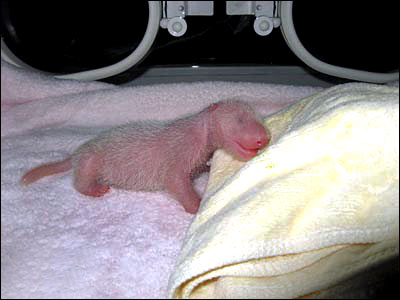
In 1990, the world's first panda twins
survived.
At night, the giant panda nursery is calm and
quiet.
Through the rhythm of the autumn rain, the sound of
cubs suckling emerges. Five giant panda mothers, Qi Yuan, Cheng Ji,
Er Ya Tou, Shu Qing and Bing Bing, are sleeping, eating bamboo, or
nursing their babies in their own "suites" and enjoying the
happiness of motherhood.
However, the personnel on duty are rather busy. They have to
help the giant panda cubs to excrete waste and feed them with milk
every four hours. They have to weigh the panda babies, take their
temperatures, and keep records on the conditions of the mothers and
their cubs.
In 2007 the Chengdu Research Base for Giant Panda Breeding
(CRBGPB) brought good news from its delivery rooms: 5 giant pandas
gave birth to 9 babies. This was a very meaningful gift for the
20th anniversary of the CRBGPB. Over the last twenty years the
CRBGPB has successfully bred 110 babies for 82 giant panda mothers.
Currently 68 giant pandas of four generations live on this base as
part of the world's largest artificial breeding species.
The United Nations awarded the CRBGPB with the "global 500"
environmental award twice, and more importantly, Chengdu has set a
successful example for the Ex Situ Conservation for the endangered
giant pandas.
The lightest 51g panda baby survived.
Two disasters
According to the standard set by the IUCN, Ex Situ Conservation
is required when the number of an endangered species is less than
1,000. At this point, experts should interfere and create a
man-made environment, such as a zoo, to prevent it from
extinction.
The Futou Mountain on the northern outskirts of Chengdu was
turned into a giant panda Ex Situ Conservation site due in part to
two disasters.
From 1974 to 1976 the giant pandas suffered through famine. The
Chengdu Zoo sent Zhang Anju to join an investigation group
organized by the State Forestry Administration to investigate the
situation on Minshan Mountain. The investigators found a total of
138 giant pandas scattered around the mountains and forests, with
some dead bodies torn apart by scavengers and others curled up in
the snow trying to protect their cubs. The tragic scene brought
tears to the eyes of even the toughest among them.
Many ill and malnourished giant pandas were sent to the Chengdu
Zoo for treatment. All of them were very skinny, infected with
ringworms, and some were too weak to bite food.
In the summer of 1983 another calamity struck this area. Arrow
bamboo around Minshan Mountain and Qionglai Mountain withered due
to the natural cycle of blooming, affecting more than 500
pandas.
Chengdu Zoo once again became the medical treatment center for
the giant pandas. About 90 percent of the giant pandas sent to the
Chengdu Zoo were saved, but since the ecological conditions had not
yet been restored in their natural habitat, recovered giant pandas
couldn't be released to the mountains and forests. From this
emerged the Ex Situ Conservation strategic thought.
During the Spring Festival of 1986, Zhang Anju, who became
director of the Chengdu Gardening and Forestry Bureau, Zheng
Shuling of the Ministry of Construction, and Hu Tieqing, Director
of the Forestry Department of Sichuan Province reached a consensus
that a "base" should be built. The base, later named the Chengdu
Research Base for Giant Panda Breeding, would not only be a
"breeding place" but also a research institute for studying the
giant panda.
Determined not to let the pandas suffer, they built houses and
planted trees, and soon large areas of bamboo spread around the
mountain and created a simulated habitat for the giant pandas.
The phase I project was miraculously finished in one year.
Difficulties confronting artificial
breeding
The success of Ex Situ Conservation depends on whether the
species whose living conditions have been changed could multiply
generation after generation.
In the early 1980s, one Beijing expert asserted that it was
difficult to artificially breed giant pandas. The difficulties
range from getting them inseminated, getting them pregnant to
raising their cubs.
Two experts, He Guangxin and Li Guanghan, told the Southern
Weekend in detail how the base solved these difficulties.
Man-reared female giant pandas could raise their rate of
pregnancy if they combined natural intercourse with artificial
insemination. In the early 1980s, the technological personnel of
the Chengdu zoo began to study the collection of frozen semen. They
found that it was later difficult to activate the sperm. In order
to solve this problem, the base learned various techniques and even
communicated with the American experts. Due to their painstaking
efforts, they finally solved this problem.
Currently the survival rate of the sperm in the frozen semen
reaches 90 percent and the sperm can be preserved for more than 100
years.
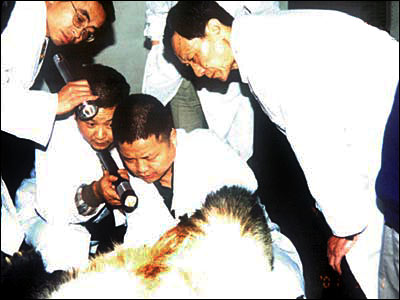
Researchers conducting artificial
insemination of a giant panda
1990: a blissful year for panda breeding
Before the year 1990, the survival rate of captive-bred cubs was
merely 33 percent. That is largely because twin cubs are
commonplace in delivery and in the wild the mother panda usually
abandons one and picks one to feed. Therefore, the postnatal
nursing work is a key factor to raising the survival rate of the
newborns.
In September 1963, the first captive-bred panda was born at the
Beijing Zoo. He Guangxin was there as a zookeeper that day and
recalled they kept the pandas in intensive care but only touched
them during feeding for fear of disturbing maternal care.
Later they developed a method to keep the mother calm while
approaching her cub. This finding made it possible to take the
abandoned cub away while she nursed the other, but they were
uncertain about how to maintain body temperature and synthesize
milk for supplementary care.
In 1988, Mei Mei gave birth to two cubs. The zookeepers wrapped
them in towels and warmed them by holding them firmly. The body
temperature was around 36 to 37 degree Celsius by measurement. This
temperature guideline was later applied to the automatic
incubator.
Determining the type of milk to use was much more difficult.
They tried almost all kinds of milk formulas ranging from cow milk
to goat milk, and eventually human milk. However, none of these
managed to save the cub's life. Japanese scientists had even
attempted to formulate artificial milk, but a vital antibody needed
was too complicated to be synthesized.
The keepers in the base finally figured out a way to make the
mother feed both of the siblings alternately while thinking there
was only one cub. Such an attempt was risky, but worthwhile. In
1989, the veterinarian Zhong Shunlong and other caretakers
attempted the switch but it resulted in tragedy as the mother Mei
Mei went on a rampage and pounced on her babies, causing their
immediate death.
In 1990, Qing Qing gave birth to twin cubs. Even though it has
previously ended in disaster, they still decided to try the
"trickery" again, because only in this way could the two cubs
survive. The breeder took one of the twins away by obstructing the
mother's view and then brought it back after the unwitting mother
had breast-fed her other baby. This time the twins successfully got
breast-fed alternately, and coupled with other nutritious
supplements, the siblings were in good health.
The base made the experience gained in breeding twin cubs known
to the public and found wider applications. Generous Qing Qing not
only breast-fed her own cubs, but aided other mother pandas. The
mother panda Ya Ya also came to help other inexperienced mothers
feed their cubs.
Panda town in the making
The base is also a talent pool, with many brilliant minds
joining the team.
"I am happy that a group of talents such as Dr. Zhang Zhihe work
at the base," Zhang Anju said, brimming with joy. These young
scientists contribute to the base in one way or another, and over
20 years, they have churned out a host of research achievements and
scholarly writings.
Zhang Anju in collaboration with a British biologist published a
book that took ten years to complete, culling 90 papers from
experts both domestically and internationally, 16 of which were
written by the base researchers.
Dr. Zhang Zhihe and Wei Fuwen brought out a book on protection
of the panda reserve. Zhao Ermi, a renowned biologist paid a
tribute to the book, saying: "The book offers a synopsis on the
protective work done in the panda reserve, and also is a good meld
of new theories and technologies."
A plan is underway to construct a "panda town" as a spin-off to
diversify the function of the base that has achieved milestone work
in protecting pandas.
Zhang Zhihe, now Director of the base, said: "There are about
200 pandas living in captivity at present. When the number climbs
to around 300, some of them can be released to the natural
habitats, contributing to a comeback for the endangered
species."
(China.org.cn by Zhang Ming'ai and He Shan, November 26,
2007)