The changing environment in China is the talk of the town - every town. It is a fashionable topic for domestic and foreign politicians, and a growing concern for people everywhere. It is also, like it or not, a source of massive profits for major businesses worldwide.
 |
|
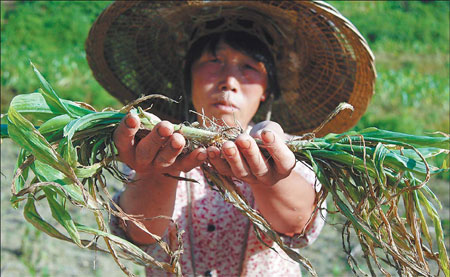
Zhou Fufang, a farmer in Machangping village, Guizhou province, shows her dying maize crops in 2005 after more than 110 hectares of land was contaminated by industrial discharges from a local phosphate mine, affecting 122 families. |
But while high-profile figures such as Nancy Pelosi, the United States House of Representatives speaker, spend their time praising different communities for their environmental protection efforts during events like the US-China Clean Energy Forum in Beijing on May 26, scientists working on the frontline have warned that slowing down climate change will take a lot more than speeches and good deeds.
The reason is because one of the biggest threats to the environment, experts say, still remains a mystery to the public.
Soil pollution is a hidden danger, albeit one just as deep-rooted as air and water contamination. But in comparison, it is the biggest threat to the planet as it can only be stopped by human intervention, said Chen Tongbin, a senior scientist with the geographic science and resources institute of the Chinese Academy of Sciences (CAS).
"It's hard for humans to pick up where Mother Nature falls short," said Chen, who, undeterred by the massive challenge, has already seen his groundbreaking research in soil recovery make progress in the fight against pollution.
About 90 percent of all wastewater in China makes its way to the fields. If that waste contains even slight traces of heavy metals, it could take at least three years for the soil to recover, he said.
About a fifth of China's arable land was polluted by the end of the 20th century, revealed official environmental figures, while waste containing heavy metals attributed to half that figure.
Every year, soil pollution affects around 12 million tons of crops and leads to the infertility of 10 million more tons, causing direct losses of more than 20 billion yuan ($2.9 billion).
There is also a massive impact on human health, with the risk of arsenic poisoning, which can also lead to potentially fatal forms of cancer, said Chen.
At least 50 million people around the globe, mostly in Asia, suffer from arsenic poisoning, said the World Health Organization. However, China boasts the largest proven reserves of arsenic, about 70 percent of the world's share, figures from Chen's environmental remediation center show.
"The widespread addition of arsenic to soil, such as in Bangladesh, is degrading soil quality and causing toxicity to rice," said Sasha Koo-Oshima, water quality and environment officer for the Food and Agriculture Organization of the United Nations. "Arsenic contamination is threatening food production, security and quality."
Arsenic has long been used as a poison in China. Today, the substance, which leading environmental health scientist Jerome O. Nriagu said was "ubiquitous in nature, with high concentrations found in polluted environments", is in pesticides, herbicides and insecticides.
Chen also explained arsenic had polluted soil across China because of the country's many mining projects.
Also, about 61.6 percent of China's arsenic reserves are stored in Hunan province, as well as southwestern Guizhou province and southern Guangxi Zhuang autonomous region. The soil there, especially those within a 30- to 40-sq-km radius of mine zones, is among the worst for arsenic pollution, said Chen, a Guangxi native.
More than a decade after his pioneering research on soil recovery reached an important milestone, 46-year-old Chen still has his hands full of with new outbreaks across China.
The latest incident made national headlines last October, when 450 villagers fell sick after drinking contaminated water in Hechi, a city in Guangxi. Four of them were confirmed to be suffering from arsenic poisoning.
Local authorities claimed torrential rain during a typhoon in September resulted in the overflow of wastewater containing arsenic on a company's premises. It was that water, they claimed, that had polluted nearby ponds and wells.
But field investigations by the Legal Weekly found no record of a typhoon in the village, while villagers, of whom 100 alleged they had been poisoned, blamed the incident on persistent arsenic pollution by the firm.
The risk to public health, albeit important, was not the reason behind Chen's research, though.
He was sparked into action by the discovery that floods in places such as Guangxi or Yunnan province were leading to crop losses and infertility in large areas of lower-reaching fields because water containing minerals from upper reaches of rivers was polluting lower watercourses.
It took him years before he finally developed a cure, or "vaccine" as he calls it, in 1999 - pteris vittata L, a plant that can efficiently suck the arsenic out of polluted soil.
Chen is reportedly the first scientist to associate the plant, a fern grown in Hunan and Guangxi referred to by locals as "centipede leaf", with soil recovery.
It was not until years after his groundbreaking discovery that the University of Melbourne in Australia started a similar project to assess the effects of four native grasses and four eucalypts on land contaminated by heavy metals.
At the time of Chen's discovery, China had less than 10 academics researching land remediation. Chen, who had only a 50,000-yuan grant to start the project in 1997, now heads a team that has received 50 million yuan in investment from the Ministry of Science and Technology alone.
China has earmarked 1 billion yuan for monitoring soil pollution and today, Chen's 40 aides come from more than 100 institutes and universities nationwide working on the subject.
But although he is no longer a one-man band, Chen is still concerned even a team of experts dedicated to heal the earth may not be on equal to the increasing pace of soil degradation.
Since it takes up to five years to revitalize polluted soil with the fern, Chen has recently tried intercropping to speed up recovery projects in Huanjiang county, Guangxi.
"We can rehabilitate the land and have yields at the same time. It could help to increase farmers' income," said Chen, who said his team had arranged the "centipede leaf" alongside cash crops like maize, sugar cane and mulberry in alternate rows.
"I don't know what magic they used, but the land is covered with plants again," said Zhou Xiaobing, 37, a farmer who was overjoyed by the prospect of his land yielding crops again.
He had waited eight years for his "miracle" after flood water from the Huanjiang River carried mineral processing industry wastes from the dams of three major mining firms on the upper reaches to lower watercourses, causing infertility in more than 5,000 mu (333 hectares) of arable land, including Zhou's 0.6 mu.
"This place didn't even grow a blade of grass at that time," Zhou said, standing beside his land, which he claimed used to yield 500 kg of grain a year.
Chen has run into a few more immediate health threats that beg to be addressed, too.
In March this year, he was intrigued by a media report about Wuzhuang, a village in the city of Tangshan, Hubei province, which neighbors Beijing.
It said that from less than 700 villagers, 10 had been diagnosed with cancer. All had lived "less than 100 m away from each other".
Another eight locals had also died of cancer in the past decade, local sources were quoted as saying. The city's center for disease control and prevention had revealed that, in Wuzhuang, a silicon and iron-rich village, people had been using contaminated hewn stones to make pickles and build yards.
Less than 12 hours after the report was published, Chen called and asked to test soil and water samples from the village. It quickly became another of his team's recovery projects.
"We can't renovate each piece of land that is polluted because it's quite costly," he said. "That's why we have to assess the severity and distribution of polluted fields and give treatment accordingly."
Zhang Shanling, head of the soil office for the Department of Nature and Ecology Conservation under the Ministry of Environmental Protection, told Xinhua News Agency last week a national soil pollution survey had come to its final stage of data collection, and the result was expected to be out by the end of the year.
The government launched China's first soil pollution survey in 2006, backed by a budget of 1 billion yuan, Xinhua reported.
The program specifically aimed to "assess soil quality across the country by analyzing the amount of heavy metals, pesticide residue and organic pollutants in the soil", it said, adding that soil recovery technologies through plants might have a market worth US$2 billion.
No legislation on the prevention of soil pollution exists in China. Talks of a relevant draft have been in the media for years, but there has nothing substantial so far.
Zhao Qiguo, a pedologist at CAS, has been heading a team of more than 30 experts in drafting the Strategy on Soil Protection since last October. Set for completion this month, the work is expected to offer key insight into legislation relating to soil protection and recovery.
(China Daily June 3, 2009)





