
Fou is an ancient Chinese percussion instrument derived from clay potteries and bronzeware. Its origin dates back to the Xia or Shang dynasties. The Fou as an instrument was not confirmed until a discovery of nearly 500 musical instruments in the Tombs for Nobles of the Yue State, Wuxi City, Jiangsu Province. Also found there were nine other varieties of instruments, including the yongzhong (a type of bell) and qing (chime stone) from the central plains, chunyu (a metal percussion instrument), dingning (a bell with a handle), duo (big bell) and ling (little bell).
It made its modern appearance during the 2008 Summer Olympics Opening Ceremony in Beijing. Towards the beginning of the ceremony, 2,008 Fou drummers staged a synchronized presentation using this instrument. Those instruments had a white square LED array surrounding each drum, allowing them all to produce both music and a dazzling display, which included characters and shapes created in tandem.
The Chinese character Fou is used to refer to containers. The character has fallen into disuse in Chinese; however, it still used to referred cans in Japanese. Since Xia and Shang dynasties, some types of those containers were used as musical instruments known as "percussion fou". Since its publicity, there has been some scholarly disputes on whether the Fou used during the Olympics were actually musical instruments, as they could simply be containers.
I. The Plucked String Instruments
1. The lute family
 Pipa - four-stringed lute with 30 frets and pear-shaped body. The instrumentalist holds the pipa upright and play with
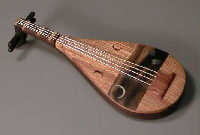 five small plectra attached to each finger of the right hand. The pipa history can be dated back at least 2,000 years and developed from pentatonic to full scales. This instrument has extremely wide dynamic range and remarkable expressive power.?
 Liuqin - a smaller version of pipa with four strings, which sound similar to mandolin. Liuqin is played with a piece of spectrum, and is used to be accompany instrument for folk songs and local opera. However, in recent decades, composer Wang Huiran made great contribution to its making and composed many pieces such that the liuqin also becomes a soloist instrument.
 ?Sanxian- A long necked lute with three strings without frets. In Chinese, "san" and "xian" stands for "three" and "strings", respectively. The sound-body is made of round wooden box covered with snake skin, just like erhu. A piece of plectrum is used to play the instrument. This instrument is often used for accompanying folk songs and local opera. The sanxian is most popular in the north.
 ?Ruan- very ancient four-stringed moon-shaped lute with long and straight neck and various number of frets, dated back at least to Qin Dynasty (around 200 BC).Ruan is used to be called "p'i-p'a" (pipa) or qin-pipa. Since the introduction of the odd-like lute through the "silk-road" in the early Tang Dynasty (around 5th century), the pipa gradually developed into the present form, and the old form of pipa with straight-neck and round body got the name "Ruan", after the name of the master player of this instrument, Ruan Xian who was one of the seven great scholars known as "The Seven Gentlemen" in Chinese history of the 3rd century (the Six Dynasties). Ruan Xian refused to serve the tyrant emperor Sima, and preferred to live as truly artist. He was persecuted. Just before execution, he performed his famous composition "Guang Ling San" in front of his students and friends to encourage them and to bit farewell. The Ruan is mostly used for Peking opera, and now also in modern Chinese orchestra. There are family of ruan of various size including "Zhong Ruan" (middle Ruan) and "Da Ruan" (large Ruan) used in the same sense as viola and cello in western orchestra.
 ?Yueqin - moon-shaped lute with shorter neck and four strings, played with a spectrum, used for accompanying local operas. "Yue" stands for "the moon" in Chinese.
2. The zither family
 ?Guqin - seven-stringed zither without bridges, the most classical Chinese instrument with over 3000 years of history.
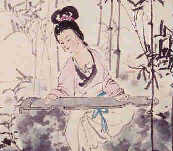 It is literally called qin yet commonly known as "guqin" where "gu" stands for ancient. Confucius (around 600 BC) was a master of this instrument. To learn to play qin used to be regarded as a very important element for education for the purpose of enriching the heart and elevating human spirit. In Imperial China, a scholars and ladies of the high society were expected to master the four arts, namely, the qin (guqin),qi (weiqi or Go),shu (Calligraphy), and hua (painting). The guqin has historically been regarded as the symbol of Chinese high culture. Unfortunately only small number of people in China could play the instrument, because classical musical education of this kind has never reached general public. The situation for today has not been improved much, which is a shame. The situation for lute pipa was similar. Due to this reason, a lot of ancient repertoire were lost with the pass-away of masters or the written scores were burned or destroyed in war or turmoil. However, the guqin repertoire has been better preserved than all other instruments.
 ?Zheng or Guzheng - Chinese zither with movable bridges and 16 - 25 strings. In the same family there are the Japanese koto, the Vietnamese dan tranh and the Korean kayagum
3. The harp family?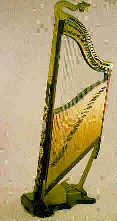
 Konghou - One of the most ancient Chinese music instruments that appeared in written texts of the Spring and Autumn period (around 600 BC). The structure of the konghou looks similar to the harp, however, with its bridges spanning the strings in the way similar to guzheng. There were the wo-konghou (horizontal konghou), su-konghou (vertical konghou) and phoenix-head konghou. Unfortunately not much of this ancient instrument has been preserved. The reproduction of the konghou started in the mid 50's. The structure of Today's konghou is a combination of su-konghou and wo-konghou with the shape similar to harp. The performing skill is diversified. Besides right-hand techniques, the left hand can play vibratos, glissandos, etc. The tone quality is mellow and graceful and has a typical Chinese flavour.
II. The Bowed String Instruments:The huqin family
 Erhu - or Er-Hu, a two-stringed fiddle, is one of the most popular Chinese instruments in the Hu-qin family, where Hu means "foreign" or "the northern folk" in Chinese.
 ?Zhong-Hu: If we call the "Erhu" Chinese violin, the Zhong-Hu is then the Chinese viola, where "Zhong" stands for "middle", thus the abbreviated name for the mid-pitched Erhu. It was developed on the basis of Erhu in the 1940s. Both the structure and performing skill of these two kinds of Hu-Qin are quite the same, yet Zhong-Hu has a deeper-sounding timbre but not as agile. Being more suitable for singing melodies (particularly some Mongolian melodies), Zhong-Hu is thus often used as tutti or accompanying instruments, sometimes for solo too.
 ?Jing-Hu: Principally used as accompanying instrument for Beijing Opera, Jing-Hu is another important two-stringed fiddle in the Huqin family. It was developed in the Qin Dynasty (around 1790), which is often called the Hu-Qin. The pitch of Jing-Hu is the highest among all instruments of the Hu-Qin family. Due to its forceful and clarion timbre, Jing-Hu is suitable almost exclusively for Beijing opera.
 ?Ban-Hu: Ban-Hu has many other names such as Pang-Hu, Qin-Hu, Hu-Hu and Da-Xian, etc. It is the leading accompanying instrument for Bang-Zi and other northern tunes or ballads, particularly for the local operas in Henan Province, central China. Similar to Jing-Hu, the timbre of Ban-Hu is clarion and bright, which makes it hard to join other instruments for tutti. Therefore it's usually for solo, especially for presenting joyful and passionate moods.
 ?Gao-Hu: Gao-Hu, also called High-pitched Erhu or Yue-Hu, is especially designed for playing Cantonese folk melodies and operas. Gao-Hu is often used for performing vivid and brisk rhythms, particularly for higher-pitched tunes that Erhu cannot play. In comparison with Erhu, Gao-Hu has louder volume yet brighter tones, and thus it servers both as solo and leading instrument in performing Cantonese operas and folk melodies.
 ?Sihu: four stringed huqin used for accompanying local opera, most commonly found in the North, such as Shanxi, Shaanxi and Inner Mongolia. It is one of the three leading instruments (together with dizi, yangqin) in "Er Ren Tai" of Inner Mongolia. "Si" stands for "four" in Chinese. The structure is similar to Erhu except it has four strings. The horse-hair of the bow is divided into two group that go between the four strings.
 ?Horse-headed qin?(Ma Tou Qin): The horse-headed qin or horse-headed violin is a typical Mongolian bowed instrument with two strings, however, very different from Er-Hu. The horse hair of the bow doesn't go between the two strings, instead, the instrument and the way of playing is more similar to cello than to erhu. The instrument was originally made from a horse head for the body, horse skin for the resonator, and horse hair for the strings and bow. The music played upon this instrument is of great variety and virtuosity. Much of the music typically sounds like human voice, and can imitate a horse to such an extent as real such as galloping horse, the whinnying, etc. The modern horse-headed qin has a wooden body and soundboard, 2 horse hair strings, and has a rich warm tone and very beautiful sound. The peghead is decorated with a detailed carving of a horse's head.
III. Hammered string instruments -Yang-Qin or Chinese dulcimer
 ?Yangqin is a Chinese hammered dulcimer with a near-squared soundboard. The instrument is very similar to Satur, play with two bamboo sticks.
(Chinaculture.org/Wikipedia August 8, 2008)