Containing a crisis
- By Ding Ying
 0 Comment(s)
 Print
Print E-mail Beijing Review, September 25, 2012


Times have changed, but Japan's militaristic ambition has not.
On September 18, 1931, Japanese militarists began an invasion of northeast China. After 81 years, two Japanese right-wing activists illegally landed on the Diaoyu Islands—an inherent part of Chinese territory—further provoking the Chinese people following Japan's illegal "purchase" of the islands several days earlier.
|
|
|
|
Overseas Chinese hold a demonstration in front of the Japanese Embassy in Britain on September 18 [Zhou Zhaojun] |
Overseas Chinese demonstrate in front of the Japanese Embassy in Indonesia on September 18 [Gu Shihong] |
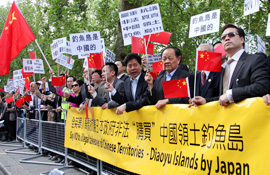
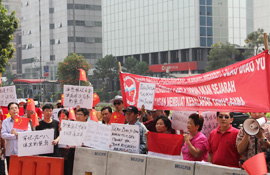
China reiterated its stance on protecting its sovereignty and territorial integrity, stressing it reserves all legal rights on the Diaoyu Islands. Observers point out that Japan's aggressive acts are a threat to regional peace and stability by challenging the existing international territorial structure formed after World War II. They have called on Japan to resume rational and peaceful negotiations on the Diaoyu Islands and get back on the track of regional cooperation.
Rousing post-war order
The Diaoyu Islands and their affiliated islands have been China's inherent territory since ancient times, until Japan stole the islands through invasion in the late 19th century. With an eye to history, China and Japan reached consensus on setting aside disputes over the islands when they normalized diplomatic relations in 1972.
Japan's recent actions concerning the Diaoyu Islands provoked strong reactions from China. Observers condemned Japan's defiance toward the victorious outcomes of World War II and the post-war international order, bringing danger not only to the region, but also to the whole world.
"Japan's actions are agitated by a far right-wing force, not nationalism," Shi Yongming, a researcher with the China Institute of International Studies (CIIS), said to Beijing Review. As an invader who inflicted severe calamities on many Asian countries in World War II, Japan should seriously reflect on its war crimes. However, since the 1980s, right-wing activists in Japan have repeatedly denied history, and the "nationalization" of the Diaoyu Islands is the latest and most dangerous move in this regard.
Japan's aggressive moves have triggered alerts in the region. Commenting on Japan's ambition over the Diaoyu Islands, the Russian Ministry of Foreign Affairs stated that Russia is willing to work with China on protecting the original post-war agreements, calling on China and Japan to handle the dispute in a civilized manner.
"Russia's attitude is concerned with the judicial basis of the Diaoyu Islands," stressed Shi Yinhong, a professor of international relations and Director of the Center on American Studies at Renmin University of China, adding that the post-war order is mainly based on documents produced during World War II.
Jin Canrong, Associate Dean of the School of International Studies at Renmin University of China, pointed out that no legal document exists to prove Japan's sovereignty over the Diaoyu Islands.
According to the Cairo Declaration and the Potsdam Proclamation, which were jointly released by China, Britain and the United States during World War II, the Diaoyu Islands should have been returned to China along with other Chinese territories after Japan was defeated on August 15, 1945. The United States gained administration of Okinawa through "trusteeship" after the war. Considering its strategic needs in confronting the Soviet Union, it betrayed its determination of strictly punishing Japan and decided instead to form an alliance in East Asia against the Soviet Union during the Cold War.
In 1951, Washington and Tokyo signed the Treaty of San Francisco without China's participation, choosing to "return" Okinawa's sovereignty to Japan. The Chinese Government released a statement on September 8, 1951, refusing to accept the illegal treaty. In 1953, the United States extended Okinawa's administration to the Diaoyu Islands, in spite of China's protests. On December 31, 1971, China reiterated its sovereignty over the Diaoyu Islands in a statement by the Ministry of Foreign Affairs. "The Treaty of San Francisco tries to legitimize Japan's so-called sovereignty over the Diaoyu Islands," said Jin.
Jin pointed out that Japan's recent actions were aimed at strengthening actual control over the Diaoyu Islands and shifting domestic focus from a poor economy to territorial disputes. He said that besides right-wing agitation and the weak government in Japan, the United States is an important source of current tensions between China and Japan.
U.S. favoritism
Although the United States declared it doesn't have a position on the Diaoyu Islands issue, its underlying bias has encouraged Japan's ambition. U.S. Secretary of Defense Leon Panetta paid a visit to East Asia recently, during which he told Chinese Defense Minister Liang Guanglie that maritime issues should be resolved via peaceful diplomatic means. However, during his Japan visit earlier, Panetta discussed with his Japanese counterpart Satoshi Morimoto the deployment of the Osprey aircraft at a U.S. Marine Corps base in Okinawa, a plan that has provoked strong local opposition.
Panetta also announced that the United States and Japan had agreed to locate the second U.S. missile defense radar in Japan to monitor possible threats from the Democratic People's Republic of Korea. Although the United States claims the missile defense is not directed at China, a military boost from the United States at such a sensitive moment could embolden Japan to take a tougher stance in its disputes with China.
Chinese experts pointed out that due to its East Asia strategy, Washington actually prefers tension or even a conflict between China and Japan. They criticized the biased stance of the United States as unhelpful to the regional situation, warning that Washington is playing a dangerous game.
Jin explained Washington's strategic targets. One is to create tension in the region to find an excuse for its strategic focus in East Asia; the other is to further control Japan, making the latter its base in the region.
Shi Yongming from the CIIS believed the United States is trying to stoke tension between China and Japan to diminish the growing influence of regional integration. In recent years, China, Japan and South Korea have jointly made efforts to establish a free trade area. The three countries make up about 22 percent of the global population; their combined economies account for 19 percent of the world total; meanwhile, their foreign exchange reserves account for 47 percent of the total worldwide. It would be the third largest free trade area in terms of total GDP next to that of the EU and North America. "U.S. stance on the Diaoyu Islands is creating divisions between the two East Asian nations by political and economic methods," concluded Shi.
However, Jin warned that Washington may be overconfident on this issue. A game involving territorial disputes is too dangerous. The United States cannot always control the supposed balance it promotes between China and Japan, both being influential countries in the world, Jin added.
Strong reactions
Japan's reckless actions sparked the indignation of Chinese people and damaged the bilateral relationship of the past 40 years. China took a series of countermeasures to express its determination to protect its sovereignty and territorial integrity. It urged Japan to make rational moves to restore regional stability.
Air defense sirens sounded at 9:18 a.m. on September 18 in Shenyang, capital of northeast China's Liaoning Province, kicking off nationwide activities marking the 81st anniversary of Japanese invasion. After Japan declared its plan to "purchase" the Diaoyu Islands, Chinese people spontaneously held protests and demonstrations throughout the country.
Fourteen Chinese ships carried out law enforcement and patrol activities in waters around the area on September 18. As fishing season begins, more than 1,000 fishing vessels from China's mainland and Taiwan also set out to fish in the waters surrounding the Diaoyu Islands.
The Chinese Government kept reiterating its stance on protecting sovereignty and territorial integrity. "Japanese right-wing activists' illegal landing on the Diaoyu Islands is a serious provocation that infringes on China's territorial sovereignty, and thus, China has made solemn representations to Japan and demanded that the country explain its endorsement of right-wing activists," Foreign Ministry spokesman Hong Lei said on September 18 in comments addressing two Japanese right-wing activists' illegal landing earlier that day. He stressed that in accordance with Chinese laws and international law, China will exercise jurisdiction over the islands and their adjacent waters.
Hong said the Japanese Government's decision to "purchase" the Diaoyu Islands is a serious violation of China's territorial sovereignty and has triggered strong protests from China. He mentioned that China's countermeasures, including the announcement of the base points and baselines of the Diaoyu Islands, surveillance fleets' patrol activities around the islands and the submission of the outer limits of the continental shelf beyond 200 nautical miles in the East China Sea to the UN, have effectively offset the legal consequences of Japan's move. He said Japan should "return to the track of negotiations" for the settlement of disputes.
Meeting U.S. Defense Secretary Panetta, Chinese Vice President Xi Jinping iterated Japan's "purchase" of the Diaoyu Islands was a farce and urged Japan to stop any behaviors that infringe upon China's sovereignty. "Japan should rein in its behavior and stop any words and acts that undermine China's sovereignty and territorial integrity," Xi stressed, adding Japan's "purchase" had openly questioned the legal effects of the Cairo Declaration and the Potsdam Proclamation and intensified the neighbors' territorial disputes.
Xi said China hopes the U.S. side can stick to the principle of regional peace and stability and speak and act cautiously, instead of getting involved in the Diaoyu Islands issue, or doing anything that might escalate current tension.
China's Defense Minister Liang Guanglie expressed hopes that the Diaoyu Islands issue will be peacefully resolved, but he warned of "further actions" on September 18 after his talks with U.S. Defense Secretary Panetta in Beijing. "We reserve the right to take further actions, but we hope the issue will be properly resolved through peaceful means and negotiations," said Liang. "I want to make it clear that the Diaoyu Islands are China's inherent territory, which is evidenced by history and law," he added, blaming Japan for "heating up" the Diaoyu Islands issue. Recently, the People's Liberation Army conducted a series of military exercises using different forces in several military regions.
"China must carry on law enforcement in the waters around the Diaoyu Islands, leaving no excuse for Japan's aggressive action of increasing tension," said Shi Yongming from the CIIS. He believed there might be a long-term stalemate between China and Japan on this issue. To Shi, the Chinese people's spontaneous resistance of Japanese goods is more effective than economic sanctions.
"Economic sanctions are an official action, which might agitate tension in the region. Currently, the most important thing is to contain the bilateral conflict over the Diaoyu Islands issue," said Shi Yongming.
Shi Yinhong pointed out that the Chinese Government has yet to impose any sanctions, but that does not mean China will never resort to economic means when its rights are offended. He acknowledged that economic sanctions will certainly bring about a negative influence on China's economy as well, but added that national dignity and territorial integrity are worth the price.


