A new stage of urbanization: A look at China Integrated City Index 2019
- By Ming Xiaodong
 0 Comment(s)
 Print
Print E-mail China.org.cn, April 16, 2021


Editor's note: The following piece on China's urbanization was written by Ming Xiaodong, official of the National Development and Reform Commission, and former minister-counsellor of the Chinese Embassy in Japan.
In the summer of 2017, I was very happy to have heard that the China Integrated City Index (hereinafter referred to as the Index) was published. At that time, I was working at the Chinese Embassy in Japan. When Professor Zhou Muzhi from Tokyo Keizai University was compiling this book, I was quite interested in his research focus and the indicators he had selected in his project. Because one of my work responsibilities when I was in China is to propose strategies and plans for China's new urbanization.
I believe that evaluating a city's development through a specific set of indicators can be a new tool and benchmark to study China's urban development and its urbanization strategy. So I wrote an E-mail to Professor Zhou, showing my appreciation for the Index and hoping that it can become a benchmark for analyzing cities' development across the world.
In the spring of 2018, when I was finishing my term and about to leave Japan, I encouraged Professor Zhou to further explore in this field and make it a routine to publish the Index annually. Actually, Professor Zhou was already preparing for his new edition of the Index. Now, it has been four years since the introduction of the first edition, and the fourth edition of the Index had already been published.
The China Integrated City Index is a system that evaluates growth performance of 297 cities at prefecture level or above across the country, which are major representatives of China's new urbanization. The Index measures urban development in three dimensions: the environment, society and economy, under which there are 27 sub-dimensions and 191 indicators that systematically depict, study and evaluate economic development, social progress and environmental improvement in 297 cities. The 191 indicators are supported by 878 data sets that contain a lot of information from which we can see the implementation of major national development strategies, the new urbanization strategy and other related policies, and identify many routine factors in urban development. Recently, I made quite a few valuable observations through studying the Index.
1. Data and facts
By comprehensively analyzing data from the Index, we can see the changes in China's urban development and urbanization process in the last few years.
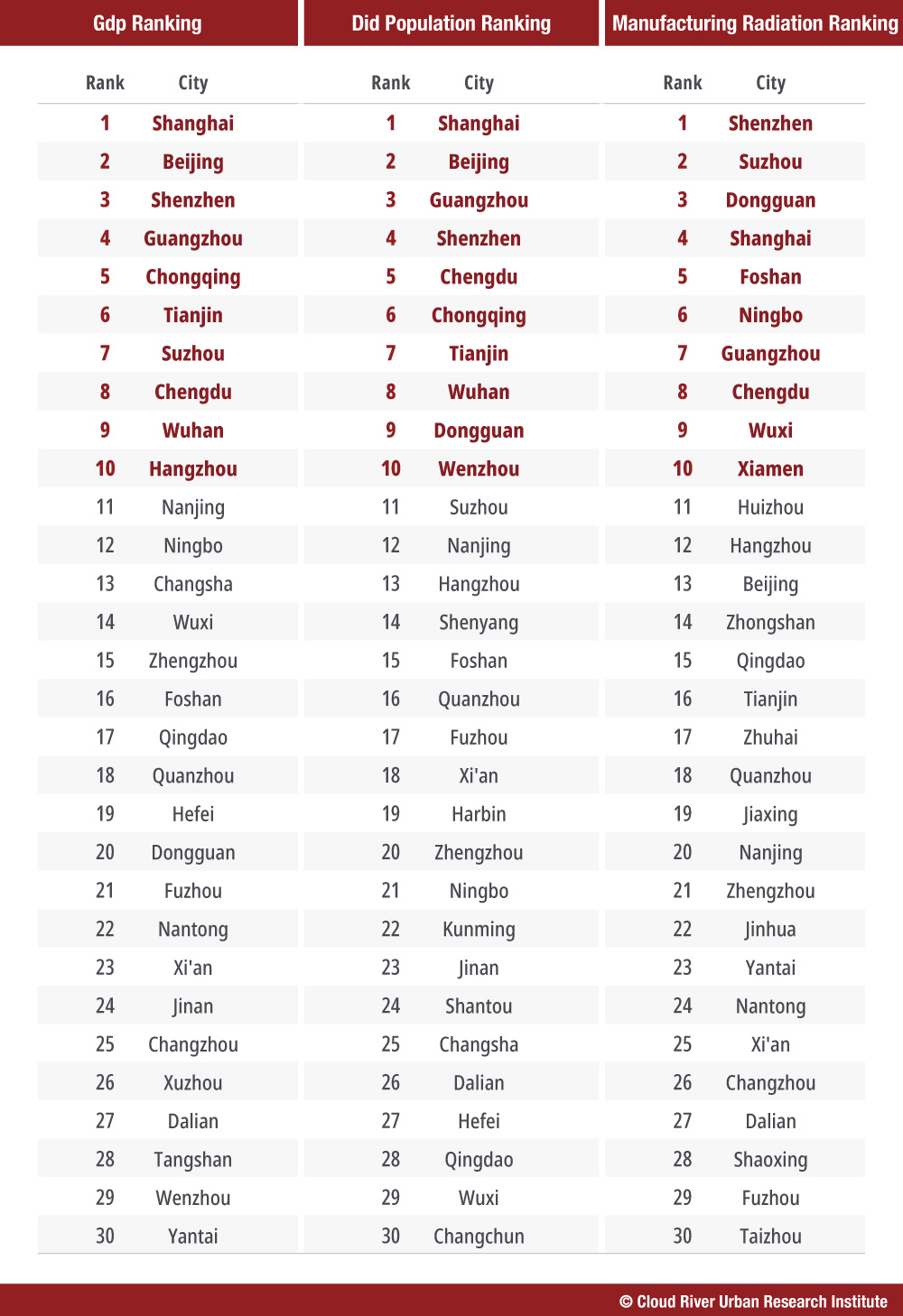
The top 30 Chinese cities by GDP, DID population and manufacturing radiation in 2019
(1) GDP ranking
From the GDP ranking and the DID (Densely Inhabited District) population ranking, the top 30 cities in terms of GDP are relatively stable. The top 10 cities are Shanghai, Beijing, Shenzhen, Guangzhou, Chongqing, Tianjin, Suzhou, Chengdu, Wuhan and Hangzhou. These cities remained in the top 10 rankings from 2016 to 2019, with slight changes in places. Geographically, the 10 cities lie in the Beijing-Tianjin-Hebei region, the Yangtze River Delta region, the Guangdong-Hong Kong-Macao Greater Bay Area, and the Upper and Middle Reaches of the Yangtze River. They are major economic growth drivers as China further opens to the world, and their combined GDP accounted for 23.2% of the whole country. The following 20 cities in the top 30 ranking have their unique geographical features. For example, Zhengzhou and Xi'an are cities in central China, locating in the Central Plains and Guanzhong Plain respectively; Jinan, Qingdao and Yantai are major cities in the Shandong Peninsula Megalopolis; Changsha is in the megalopolis of the middle reaches of the Yangtze River; Dalian is in the coastal area of Liaoning province; Fuzhou and Quanzhou are in coastal area of Fujian province; Changchun is in the Harbin-Changchun Megalopolis. By DID population, these cities are in different echelons of development.
(2) DID population ranking
Among the top 30 cities in the GDP ranking of the China Integrated City Index 2019, only five didn't appear in the top 30 cities in the DID population ranking, which shows strong correlations between the population and economic factors. The top 30 cities listed in the 2017 and 2019 DID population rankings are the same, with only minor changes in their places. Shanghai, Beijing, Guangzhou and Shenzhen maintained their places in the top 4; cities like Chengdu, Nanjing, Hangzhou, Quanzhou, Fuzhou, Zhengzhou, Kunming, Jinan, and Changsha moved higher in the ranking; Tianjin, Shenyang, Xi'an, Ningbo, Shantou, Hefei, Qingdao, Wuxi and Changchun slipped down the rankings. These changes indicate that megalopolises in eastern China have maintained strong attractions, with obvious and continued flow of populations from central and western part of the country to the coastal areas. At the same time, with the outflow of population in central and western areas as well as the northeastern areas, populations are becoming more concentrated in major cities of those regions.
(3) Wide-area analysis of population flow
As we carry out an analysis in a wide area to study population flow, we find out that the top 10 cities with the most population inflow in 2019 are Shanghai, Shenzhen, Beijing, Dongguan, Guangzhou, Tianjin, Foshan, Suzhou, Ningbo and Hangzhou, while the top 10 cities with the most population outflow are Zhoukou, Chongqing, Bijie, Fuyang, Xinyang, Zhumadian, Nanyang, Shangqiu, Zunyi and Maoming. Comparing the figures between 2016 and 2019 in terms of the size of the cities with population inflow and outflow as well as their place changes in the ranking, we can see transformations in the size of migrant populations. Population flow can be seen in the following features as we study the statistics of migrant populations. First, the number of migrant population is declining. China's migrant population has dropped from 245 million in 2016 to 236 million in 2019. Second, the proportion of intercity migrant population is growing. If we take a closer look at the ranking changes in terms of population inflow, population outflow and DID Population, we can see the proportion of intercity migrant population is continuously increasing. In 2019, the proportion of population migrating from counties and cities were 45.1%, up by 6 percentage points over the previous year, demonstrating a quick upward trend. Third, regions with population inflow is diversifying. The general trend for population flow had always been from the central, western and northeastern part of the country to the eastern coastal areas. According to statistics on population flow, however, some major cities in central, western and northeastern regions have seen remarkable increase in DID Population. There are once even signs that central and western regions are experiencing population inflow.
2. Analysis and findings
Based on the data concerning economic aggregate and migrant population provided by the China Integrated City Index, a comprehensive analysis of statistics of manufacturing radiation, higher education radiation, science and technology radiation, as well as container port convenience can lead to the following findings.
(1) City spaces form new pattern
The 11th Five-Year Plan took megalopolises as the main form for promoting urbanization. After more than 10 years of development, Chinese cities have given full play to agglomeration effects, as their population, resources, technologies and other factors were rapidly funneled to central cities and megalopolises, the economy of administrative regions has turned to the economy of metropolitan areas and megalopolises, and urbanization has polarized in terms of spaces and functions. Centered on Beijing, Shanghai, Guangzhou, Shenzhen and other mega cities, for instance, the Beijing-Tianjin-Hebei region, the Delta River Region, and the Guangdong-Hong Kong-Macao Greater Bay areas – three world-class megalopolises, were formed. Centered on Qingdao, Jinan, Yantai, Xi'an, Dalian, Changchun, and Fuzhou, megalopolises, such as the Shandong Peninsula, the Liaodong Peninsula, the Harbin-Changchun Area, Fujian's coastal area, and the Central Plains have been formed, becoming China's new driving force areas for economic growth. At the same time, a number of metropolitan areas and central cities have emerged as China new areas of growth poles. As megalopolises have become the main form of urbanization, the power system for national development has taken shape, comprised of main power areas, emerging power areas and new areas of growth.
(2) Development of cities polarizes
The China Integrated City Index introduces the concept of DID (Densely Inhabited District) population, well solving the data distortion of urban population density caused by the fact that urban areas include rural areas, and truly identifying changes of urban population. For example, Chongqing is a city with a net outflow of population, but its DID population has increased remarkably in recent years. If we only gauge the population change by administrative districts instead of DID districts, we will misjudge the trend of urban population changes. Aided by DID population data, many problems emerging from urban development can be spotted. For example, seen from the analysis of the DID population ranking year by year, DID populations increase significantly in some cities, but decrease quickly in other cities, showing that China's urban development features polarization. In particular, populations of some medium and small-sized cities in China's central and western regions, and China's northeastern regions continue to drop, resulting in nearly 100 cities across China having their populations shrink. Those cities are divided into two categories: One is that its population continues to decrease, but its population structure almost remains the same, and its economy maintains a steady growth; the other one is that its population dwindles away, its aging population grows, its industries shrink, and its economy is in a downturn.
(3) Urbanization development exhibits new pattern
For a long time, China's urbanization development has been largely driven by population movement between urban and rural areas, as a lot of surplus laborers in rural areas headed for cities for a job, leading to an increase in the permanent resident population in urban areas. China's urbanization rate thus rose from 17.9% in the beginning of reform and opening up to 60.6% in 2019. Looking into DID population ranking and the wide-area analysis of population movement, we found that the balance of cities' DID population flips, showing that population movement between cities has been a trend. Although cities in eastern China have more inflowing population than outflowing population, those cities saw their migrant workers decreased by 480,000 in 2016, and the figure climbed to 1.08 million in 2019, meaning that the population flowing between cities joined urbanization. Getting an urban permanent residency was once a dream for youth in rural areas. However, many migrant workers now are reluctant to settle down in cities although many cities have lifted hukou restrictions. What can be concluded is that changes will happen to the driving force and the pattern of China's urbanization.
3. Goals and tasks
The analysis above shows that with the spatial pattern for China's urbanization already established, most cities have removed restrictions on urban permanent residency for people from rural areas, and have boosted their comprehensive carrying capacity. The tasks of promoting urbanization, improving the spatial pattern for urbanization and strengthening management of urban planning and construction laid out in the 11th Five-Year Plan have been completed, ushering in a new stage of China's urbanization with new goals and tasks. After an initial analysis, focus on work should be gradually shifted to eliminating the urban-rural dichotomy, promoting integrated urban-rural development and invigorating medium and small-sized cities.
(1) Overcome urban-rural dichotomy
The urban-rural dichotomy is the major cause of the widening gap between the rich and the poor and the unbalanced regional development. China's urbanization rate has surpassed 60%, the relations between urban and rural areas have undergone great changes, so focus should be placed on eradicating the urban-rural dichotomy. First, we should lift restrictions on granting urban permanent residency to people from rural areas, so that residents are allowed to choose where their household registration is, and we should realize the free transfer of household registration. No matter from rural or urban areas, migrant population is an important component of urban population. There should be new cities, rather than migrant workers, so that new citizens and their families have the freedom of horizontal flow, but also have the opportunity of mobilizing upward vertically and entering the middle-income group. Second, the rural land management system should be reformed so that rural collectively owned profit-oriented construction land is allowed to enter the market with the same rights and at the same prices as state-owned land, and farmers can financially benefit from land. Third, we should improve public service allocation, promote the allocation of public services based on population, and allow residents, irrespective of their groups and social strata, to have access to public services of the same quality.
(2) Improving integrated urban-rural development
"Over density" in cities and "over sparseness" in the countryside are the two problems that ailed China's neighbor Japan during its rapid urbanization. More than half of its population concentrates in its three major metropolitan areas, its rural areas suffer from population aging and hollowing-out and the country depends heavily on grain imports. China, who also has been urbanized quickly, should learn from Japan's lessons, and promote integrated urban-rural development to ensure the prosperity of both urban and rural areas. Promoting integrated urban-rural development hinges on interaction between urban and rural areas. Cities should channel capital, technologies, and personnel into rural areas to gain benefits from the agricultural development, and promote personnel exchanges between urban and rural areas. Rural areas should develop scale business, provide cities with raw materials and farm products, and promote the integration of industries in urban and rural areas. At the same time, we should encourage centralized residence of rural residents, extend urban public services to rural areas, and equalize urban-rural access to public services.
(3) Invigorate medium and small-sized cities
Currently, some of China's medium and small-sized cities are experiencing population drop, industrial contraction and a weak economy. Maintaining a fairly number of healthy medium and small-sized cities is key to an urban system. These cities, including counties, are in proximity to rural areas and enjoy a close connection with neighboring large cities, so they serve as an important bridge for promoting integrated urban-rural development. Developing medium and small-sized cities is conductive to undertaking functions of neighboring cities, and providing development space for large cities. It also helps farmers nearby develop urbanization in their localities, to ensure the sustainable development of rural areas and farming culture. Therefore, we should give priority to developing medium and small-sized cities on the agenda of future urbanization, sale up effort to build medium and small-sized cities, keep improving the living environment in cities, accelerate the building public facilities, enhance quality of public services, and strengthen industrial supporting capacity.
(4) Promote renovation and upgrading of cities
Since reform and opening up, the size of built-up areas in Chinese cities has expanded at a fast pace amid the country's fast urbanization. The growing-fast urban sprawl was accompanied by large numbers of shoddy buildings, and many high-quality buildings are getting older, so cities are in urgent need of renovation. Japan has designated organizations for urban renovation, which are tasked with giving cities' old buildings and structures a facelift. With the establishment of China's land space planning system and the strict demarcation of the boundary of urban development, cities will shift from getting bigger to renovating internally. Renovation can beautify old cities, add appeal to old cities, and improve living conditions for residents. It also helps advance the building of smart cities, cultural cities, and healthy cities, and better satisfy needs of urban dwellers who are pursuing a good life.
Opinion articles reflect the views of their authors, not necessarily those of China.org.cn.
If you would like to contribute, please contact us at opinion@china.org.cn.


