Wuxi, city of the Grand Canal
 0 Comment(s)
 Print
Print E-mail China Today, April 25, 2017


The city of Wuxi is a time-honored hub for commerce and transportation in southern Jiangsu Province. Through it runs the Grand Canal. Lying west of Shanghai and east of Nanjing, bounded northward by the Yangtze River and with Taihu Lake to its south, Wuxi is at the core of the vibrant, densely populated Yangtze River Delta.
|
|
|
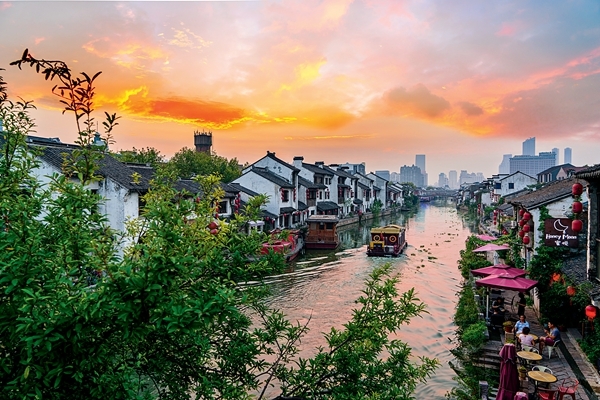
Rivers endow the city with a complete water transportation network. |
Known as the "land of fish and rice" and historically one of China's four main rice markets, Wuxi has been a land of affluence throughout history. In modern times it nurtured Chinese national industry and commerce, with the help of such "patriotic capitalists" as Rong Yiren, founding chairman of the financial conglomerate Citic Group, and his family in the early 20th century. With the onset of China's reform and opening-up in the late 1970s, Wuxi's small, private enterprises blazed the trail towards a market economy.
The city's rich historical heritage, efficient water transportation, and industrial and commercial culture reflect the spirit of Wuxi.
Historical Heritage
Wuxi was first mentioned in historical records some 3,000 years ago, but its earliest inhabitants made their homes there 6,000 to 7,000 years ago. Taibo, founder of the State of Wu, led his people southwards from the Central Plains to Meili (now Meicun Village) of Wuxi. There they built walls to guard their settlement and established the Kingdom of Wu, which existed until it was absorbed by the Yue Kingdom in 473 BC.
Both the Wu and Yue kingdoms set great store by martial qualities. However, this changed in the fourth century AD, when the nobility fled the war-torn north to find refuge in the lower reaches of the Yangtze River. These patricians introduced to the area their genteel pursuits and decorous sensibilities which eventually transformed the locale's aesthetic orientation. The resultant "Wuyue culture" remains synonymous with the refined elegance of high Chinese culture.
|
|
|
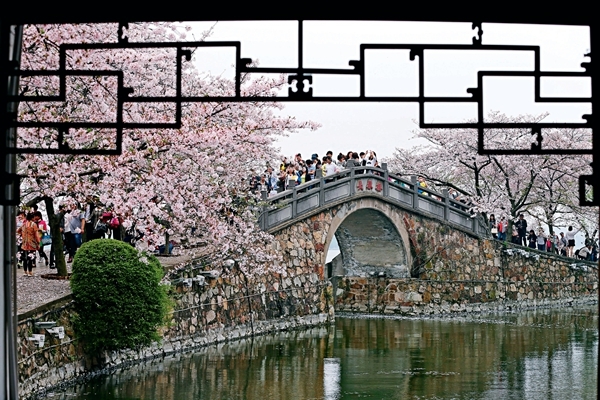
Visitors come to Yuantouzhu Isle for blooming sakura flowers. |
Bountiful resources and a blessed natural environment made the lower reaches of the Yangtze River China's most affluent region. In the seventh century it supplanted North China as the country's economic center. As the seeds of industry and commerce began to sprout and flourish, to Wuxi's social milieu was added the element of sumptuous consumption.
The city has now hitched its rich cultural heritage to the engine of social development. The film and tourism industries have exploited to full advantage such historical sites as the Hongshan ruins and Helü City site. Historical districts and parks devoted to Buddhism and Wu Culture are now places for public recreation. The original outlook and customs preserved in Wuxi's 10 ancient villages also draw visitors from around the country.
Wuxi's intangible cultural heritage has become interwoven with the fabric of daily life. The centuries-old Huishan Temple Fair is held annually for an entire month. The intangible cultural heritage exhibition there draws hundreds of thousands of visitors. The ancient Nanshui-xian Daoism Temple has been adapted into a museum of sacred Taoist music. In the silk museum, originally an old factory, are installations that depict the old processes of silk weaving and dyeing. Heping Theater is the venue for performances of Xiju Opera and pingtan – storytelling and ballad singing in the local dialect.
Water Town
Wuxi's crisscrossing rivers endow the city with both beautiful scenery and a complete water transportation network. Wuxi is northeast of Taihu Lake, China's second largest body of fresh water. Low, rolling hills surround the lake while Mashan Mountain and Yuantouzhu Peninsula append it like two horns. The best view of the lake is on bright days when rays of sun glint on the rippled surface. The 30-40-km-long lake shore is now a scenic zone with free public admission.
The 1,797-km-long Grand Canal runs through six provinces and municipal cities, starting from Zhejiang Province all the way northwards to Beijing. The canal in Wuxi territory has a 40 km span, connecting the Yangtze River and Taihu Lake.
|
|
|
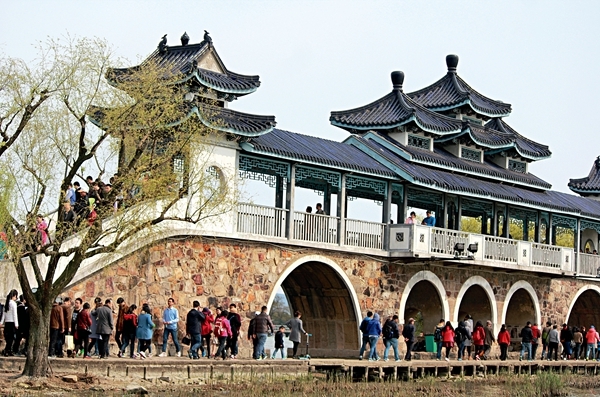
The Huixian Bridge on the Taihu Lake. |
China's history of cutting channels, however, started in the 11th century BC, in the early days of the Wu Kingdom. The purpose of the first canal, called the Bodu River, was for irrigation and draining floodwater. During these times of sparse land transportation the canal was vital both for civil transportation and military logistics.
The Bodu River, having witnessed the city's ebbs and flows over the past three millennia, has become a part of the life of local residents. The best of Wuxi's scenery can be enjoyed on a boat trip from Huangbudun Isle to Nanchan Temple and onward to Qingming Bridge. The many bridges that span the river have been built throughout history. Each relates to particular events in the life and times of the city and people.
Lu Yu (733-804), the so-called Sage of Tea, called Huishan Spring, at the foot of Huishan Mountain, the "second spring of China" in his highly-regarded monograph The Classic of Tea. Huishan has since been thus referred to throughout the country. After filtering through rock strata this water indeed has a clean taste. Tea drinkers travel across the country especially for this spring water to brew their favorite beverage.
It is thanks to Taihu Lake that Wuxi has so long been the water transportation hub in this area, and hence enjoyed economic prosperity and a burgeoning population. The local residents that congregate along the Grand Canal form the city's old downtown area.
Cradle of Modern National Industry and Commerce
After the founding of the People's Republic of China in 1949, Wuxi entered the fast track of industrial and commercial development. When China adopted the reform and opening-up policy in the late 1970s, Wuxi, along with neighboring cities Suzhou and Changzhou in southern Jiangsu Province, encouraged the growth of private, small-scale enterprises in townships and rural areas.
Southern Jiangsu Province provided a model of industrialization for other cities to follow. Huaxi Village of Wuxi is this successful mode in miniature. It has helped 20 other neighboring villages to develop, so forming a 35-sq-km development zone. The 30,000 or more residents in the zone are moderately well-off and have easy access to expressways, water ways, and heliports.
Wuxi's industrial and commercial foundation was laid in the early 20th century. Many Wuxi people flocked to the then Oriental metropolis of Shanghai, just 128 km away, looking for opportunities. Instead of trading, Wuxi businessmen mostly engaged in commodity production, such as cotton and flour. The Rong family was the most well known in this respect.
Successful Wuxi businessmen accumulated enormous wealth which they expended on building private gardens and villas, as well as public parks. These constructions embody the tastes of traditional Confucianism and also exotic interest and charm. Gong Park, Jichang Garden, and the gardens on Yuantouzhu Isle stand testament to Wuxi's unquestioned status in the history of Chinese modern gardens.


