A mystical metropolis on the Snowy Plateau
 0 Comment(s)
 Print
Print E-mail China Today, October 13, 2017


Lhasa, the 1,400-year-old capital of Tibet Autonomous Region located in its southeast, is among the world’s highest-altitude cities. The region’s political, economic, cultural, and religious center, Lhasa, which in the Tibetan language means Sacred City, is the starting point for tours of Tibet, and has become even more popular since the modernization of its infrastructure. But these advances in no way encroach upon Lhasa’s sun-bathed, snow-capped mountains and grasslands, pristine air, ancient beliefs, and serene lifestyle. Whether in the Potala Palace, Jokhang Temple, Norbulingka or Barkhor Street, Lhasa offers ample sources of sustenance for the soul.
Songtsen Gampo and Princess Wencheng
Clans and tribes, large and small, appeared on the Qinghai-Tibet Plateau around the first century AD. After years of war, they merged and united to form a tribal alliance. In the year 632, Songtsen Gampo built a fortress in the wilderness, cleared river routes, and constructed monasteries, so laying the foundations for Lhasa, and established the powerful Tubo Kingdom.
|
|
|
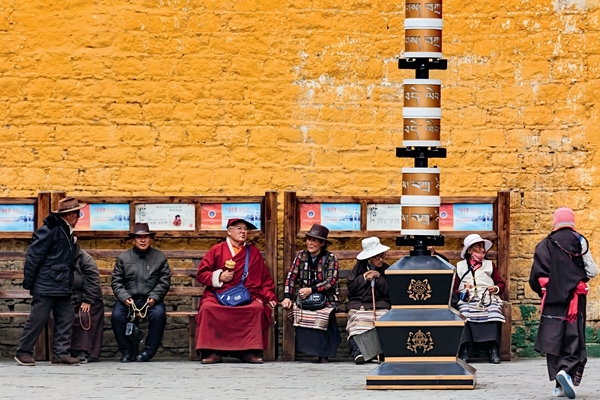
Barkhor Street preserves the traditional features and lifestyle of the ancient city. |
To consolidate his rule, Songtsen Gampo sought an alliance with Tang Dynasty Emperor Gaozu of the Central Plains area. This he achieved through his marriage to Princess Wencheng, the emperor’s daughter. Soon after he built the Potala Palace in Lhasa, on Mount Maburi. During the later decline of the Tubo Kingdom the palace was destroyed in successive years of war and natural disasters. Today’s Potala Palace was rebuilt on the original site.
The Jokhang Temple was constructed around the same time as the old Potala Palace. It is said that Sakyamuni the Buddha opposed idolatry and the building of temples and statues, but eventually assented to statues of him at three different ages, and personally painted pictures in this respect. Among the statues of Buddha, the gilded bronze one of the 12-year-old Sakyamuni created in India is considered the finest. Princess Wencheng brought it with her to Tibet from the Central Plains area of China, and placed it in Jokhang Temple. The statue is priceless, not only by virtue of its historical value and as a cultural relic, but because Buddhists believe that beholding this image is equivalent to seeing the Buddha in his original incarnation 2,500 years ago.
There exist many historical accounts and folk legends about Princess Wencheng’s journey to Tibet and what she accomplished there. They show that the princess was indeed committed to exchanges and communications between the Tubo Kingdom and the Tang Dynasty, and that she was integral to the development of the friendship between the two. This cultured and knowledgeable princess exerted tremendous influence on Tibet’s openness. This is apparent in her recommendation to Songtsen Gampo that the children of Tubo nobles be sent to the Tang capital to study and acquire the Han’s advanced knowledge and culture.
|
|
|
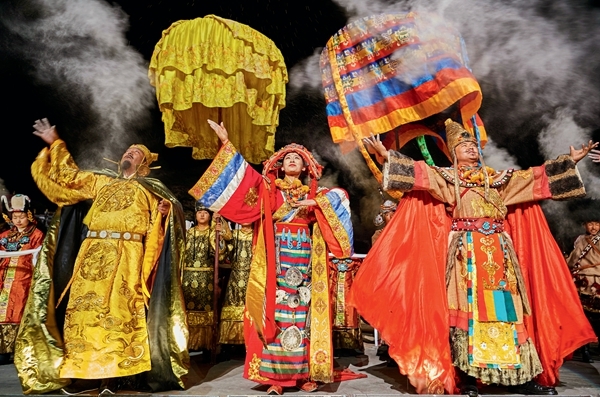
Stage photo of the large-scale epic drama Princess Wencheng. |
Princess Wencheng not only introduced to Tibet Tang milling and pottery techniques, medicine, agriculture, and textiles, but also Buddhist scriptures, and books on medicine, history and agriculture, among others. She thus helped to advance Tibet’s economy and culture, and her memory is consequently loved and respected by the Tibetan people in the many temples dedicated to her.
Lhasa and Buddhism Lhasa is a city of temples.
Local residents and pilgrims walk the streets of Lhasa, spinning its many prayer wheels. Their devotions evoke a feeling of deep humility. Pilgrims from afar making their sacred journey to the holy city of Lhasa prostrate themselves every few steps of the way as the ultimate expression of their devoutness. Worshipping at Jokhang Temple is their lifelong wish.
In the 13th century, the central government of the Yuan Dynasty (1271-1368) incorporated Tibet into its unified territory, and gradually strengthened the region’s local authority. In the mid-17th century, Qing Emperor Shunzhi officially conferred on Lobsang Gyamco the title of the 5th Dalai Lama, so establishing a theocratic feudal serfdom with Lhasa as its capital, and strengthening the Dalai Lama’s Gelug Sect. Lhasa has since remained the capital of Tibet.
In 1645, the 5th Dalai Lama rebuilt the Potala’s White Palace and made it his living quarters and place of work. After completion of the pagoda containing the 13th Dalai Lama’s remains in 1936, the Potala Palace was expanded to its present scale. The 5th Dalai Lama also expanded the Jokhang Temple, an important monastery under the jurisdiction of the local government of Tibet, and site of its administrative offices. The Golden Urn, from which lots are customarily drawn to select the living Buddha, is housed in Jokhang Temple, where the ceremony to choose the current 11th Panchen Lama Gyaincain Norbu in 1995 is held.
There are now more than 200 temples in the city of Lhasa. Since 1980, the state has invested heavily in the maintenance of 97 ancient edifices in the city, including Jokhang Temple and the Potala Palace.
A “Heavenly Road” on the Plateau
Lhasa is on the Qinghai-Tibet Plateau – the world’s highest. Owing to its remote location and consequently difficult logistics, local residents were until recent times firmly entrenched in the region’s autarkic manorial economy. In 1949 Tibet had just one one-km-long surfaced road. American travel writer Paul Theroux wrote in his book Sailing Through China: “The Kunlun Mountains preclude any railway to Lhasa.”
|
|
|
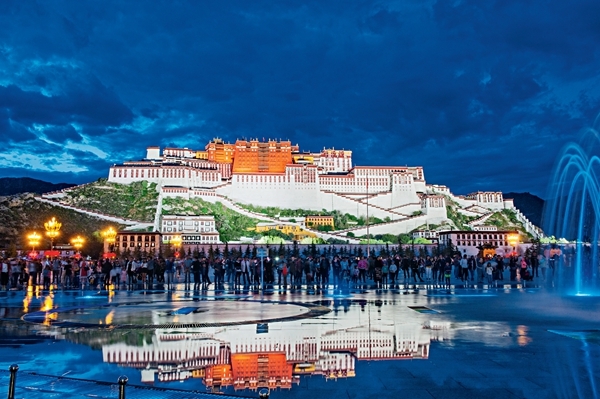
Night scene of the Potala Palace. |
In the 1950s, the central government nevertheless decided to build a railway to Lhasa. In 1956, the Ministry of Railways carried out a comprehensive survey of Tibet to work out the planning and design for this task. After decades of research and debates, in June 2001, the railway connecting Golmud in Qinghai to Lhasa started construction. Its main obstacles were permafrost, a cold and anoxic environment, and fragile ecology. Having overcome all three, in July 2006 the railway started operation.
The Qinghai-Tibet Railway, with a total length of 1,956 kilometers, is the first railway to Lhasa and the world’s highest, which is why it is known as the “Heavenly Road.” The railway goes through the Hoh Xil, Sanjiangyuan, Qiangtang and other national nature reserves. To protect the plateau’s blue skies, clear lakes, and wildlife, the State Environmental Protection Administration, Ministry of Land and Resources, and Ministry of Railways formed a joint expert group on preserving the ecological environment.
After in-depth research, the team formulated specific environmental protection measures. To protect the living environment of wildlife such as the Tibetan antelope, the railway established 33 wildlife channels, and to preserve wetlands it constructed the first man-made wetland in the alpine region. In efforts to protect the landscape, achieve zero emissions, and improve the ecological environment along the railway, it also built a green corridor that stretches for hundreds of kilometers. These unique environmental designs, construction and operation concepts render the Qinghai-Tibet Railway China’s first “green railway.”
There are other choices of transport to Tibet in addition to the railway, notably by road. China National Geography magazine called the Sichuan-Tibet Highway one of the best sightseeing routes in China. It provides a breathtakingly beautiful, ever-changing landscape from the Chengdu Plain to the Qinghai-Tibet Plateau, and the chance to experience four seasons in one day. People walk, ride and drive along this road.
Lhasa Today
Convenient transportation has provided the conditions necessary for Lhasa’s development.
Historical records show that Lhasa’s urban area in 1950 covered less than three square kilometers, and had only 30,000 residents. The city had neither water-supply lines nor sewers, and none of the roads was surfaced. Groups of girls fetched water in wooden pails from the foot of Chakpori Mountain and the Lhasa River every morning.
|
|
|
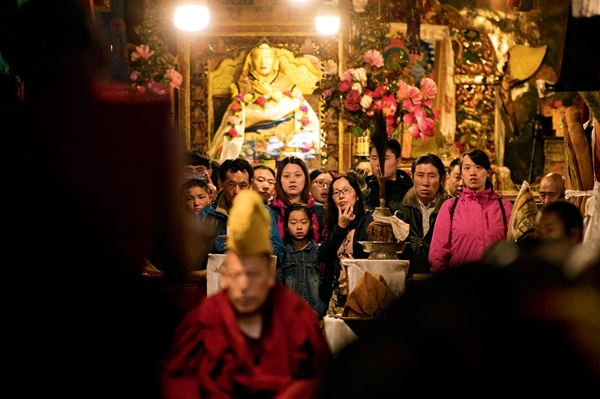
Visitors watch a ceremony at Drepung Monastery in Lhasa. |
At the end of 2012, Lhasa invested about RMB 1.5 billion in preserving the old city. After six months of construction, the circumambulation paths around the Jokhang Temple had been widened, and vendors on Barkou Street no longer traded outdoors. The backward municipal infrastructure was modified, and streets and lanes in the old city were made neat and orderly.
Urban planning continues to enlarge the city of Lhasa. Its 60-sq-km area is 20 times larger than it was decades ago. The city region straddles the Lhasa River, making it Lhasa’s second administrative district. There are 100 or so inns and restaurants along the riverside, whose banks are also venues for drama performances such as that paying tribute to Princess Wencheng. Having debuted in August 2013, the play is now synonymous with the city.
Today, with the Potala Palace at its core, row upon row of high-rise buildings dotted with gardens have formed a modern city. Its flourishing hotels, banks, shopping malls, and designer shops make one forget Lhasa’s remote location on a snow plateau. The popularity of mobile phones and Internet also connects the city with the world outside.
Walking along the bustling Barkhor Street, and seeing devout believers in the Potala Palace square, one will be touched by the sincerity of the people’s faith. Spinning prayer wheels, listening to the sounds of the city from a teahouse on a sunny afternoon, or strolling along the Lhasa River make it impossible not to fall in love with Lhasa.


