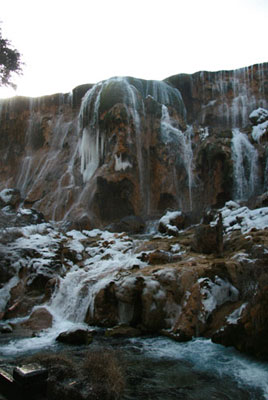
Jiuzhaigou becomes a
fairyland full of glittering ice waterfalls and snow-capped
mountains each winter. This year, the icy season is expected to
last through March 31. Located in the Aba Tibetan-Qiang Autonomous
Prefecture in southwestern China's Sichuan Province, Jiuzhaigou was
listed as a UNESCO World Heritage Site in 1992. [Photo:
CRIENGLISH.com]
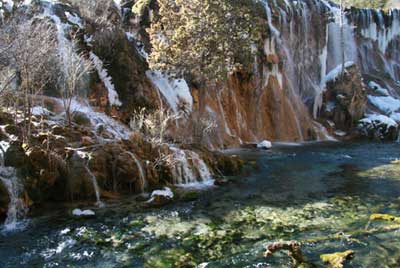
With its snow-capped mountains, glittering and translucent ice
waterfall and sapphire lakes scattered among the valleys,
Jiuzhaigou is an enchanting winter destination.
The striking blend of the blue water and grayish trees composes
a more profound visual effect of cold beauty, providing a pleasant
contrast to Jiuzhaigou in autumn, its peak season.
Many visitors who attended the fourth Ice Waterfall Tourism
Festival earlier in January were surprised at how well-preserved
the area's natural resources are, considering that 20,000 visitors
flock to Jiuzhaigou daily during the peak season.
Jiuzhaigou, widely considered one of the most beautiful places
in China, was listed as a World Heritage Site in 1992. It is also
credited as a geographic park and a 5A-level national scenic
spot.
As the only domestic scenic spot with these three designations,
it has become a hot destination for tourists. Despite its remote
location in Aba Tibetan-Qiang Autonomous Prefecture, every year
vast numbers of visitors come to drink in the beautiful landscape
and experience the exotic Tibetan culture. As a result, over the
past decade, many changes have taken place in this once-quiet
valley.
Tourism has now become Aba's major industry; statistics show the
area received 8.8 million visitors and tourism revenues of more
than 7.4 billion yuan last year. Yet, most visitors travel many
hours just stay for a day or two. Why does it seem that people are
not content to remain in Jiuzhaigou? With its abundant cultural
offerings from nine ethnic villages, the area certainly doesn't
lack the human element that is often part of a destination's
appeal. So what's missing from this remote wonderland?
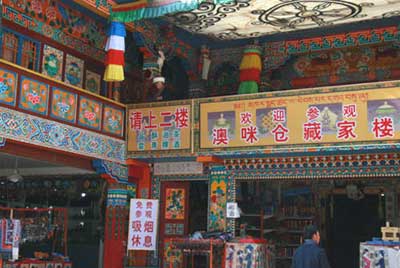
Luosangdongzhu, a local
Tibetan resident, has converted his family's home into the Aomicang
Tibetan House, a family-style store. The business sells suyoucha, a
buttered tea, or qingkejiu, a barley alcohol, as well as some daily
necessities to visiting tourists. [Photo:
CRIENGLISH.com]
Tourism Impacts on Local Life
The valley is home to more than 1,000 Tibetans from nine
villages. When the local government began developing the tourism
industry, arable lands were reclaimed for reforestation or
tourism-related construction, and local farmers and herdsman found
new livelihoods to survive in a region now dominated by
tourism.
At the folk culture park in Shuzheng Valley, the largest of the
nine local communities, almost every household has been converted
into a shop dealing in Tibetan stone accessories, silver ornaments,
leather hats or other local handicrafts. Though the products barely
differ from shop to shop, curious visitors often hop from
door-to-door to experience as much local flavor as possible.
Luosangdongzhu runs the Aomicang Tibetan House located at the
entrance of the park. He adapted his home into a family-style shop,
where visitors can taste suyoucha, a buttered tea, or qingkejiu, a
local barley alcohol. The shop also sells daily necessities. After
years in business, the family has made big money in step with the
rising number of visitors. Luosangdongzhu said he spent about
300,000 yuan building the house a couple of years ago. With its
combination of red, blue and yellow figures covering the walls, the
house now represents what outsiders imagine to be a typical Tibetan
family.
The tide of tourism has brought prosperity to the locals, who
were formerly isolated in the deep valley, and the concept of an
outside world has become more of a reality as they meet and greet
visitors from around the country and abroad.
Kangzhuzeren, 20, wants to be a taxi driver inside the scenic
area. His family began running a photography business in 2000. In
addition to taking basic photos from their stand inside the park,
they rent ethnic costumes and when it was permitted, a yak, for
added flair. They charged one or two yuan to rent a costume when
they first opened, but the price has now risen to ten yuan. In the
peak season, the family can earn 10,000 yuan per month, a figure at
least on par with the incomes of some urban white-collar workers.
The owner of a small local supermarket said he has to import goods
daily from Chengdu, the provincial capital, during the peak
season.
The tourism boom has so far stimulated the economy without
destroying the area's natural beauty. But keeping up with travel
trends often comes at a cost. People don't necessarily want to come
and see just the mountains anymore. Now, they want a combination
vacation package full of cultural and interactive elements, rather
than a simple, return-to-nature getaway.
Jiuzhaigou becomes a
fairyland full of glittering ice waterfalls and snow-capped
mountains each winter. This year, the icy season is expected to
last through March 31. Located in the Aba Tibetan-Qiang Autonomous
Prefecture in southwestern China's Sichuan Province, Jiuzhaigou was
listed as a UNESCO World Heritage Site in 1992. [Photo:
CRIENGLISH.com]
Establishing a Favorable Tourism Environment
But how should the local government deal with the potential
conflicts between the local communities and tourism industries?
What can be done to maintain a balance?
"Potential conflict between local communities and the
development is likely, if the integration is not well-managed. And
if there are no educational programs or awareness programs, things
can go wrong," Xu Jing, director of the Asia Pacific Region of the
United Nations World Tourism Organization, said.
"Tourism is like the relationship between water and a boat. On
one hand, the water can support the boat, but on the other, it can
also upend the boat -- it depends how you do it," he said. He
praised Jiuzhaigou as a good example of a balanced approach between
the two.
A favorable environment for tourism must offer multiple
attractions. In future, Xu thinks Jiuzhaigou should focus on
complementing the natural beauty with cultural products.
"So far it is mainly concentrating on the natural resources, but
to retain those natural resources as the core element, like the
petals on a flower, you need the side product to support it. I
think a cultural element, like the one here (at the Sheraton
resort), the Tibetan culture or other historical resources would
function as the green leaves to those flower petals, essential to
their survival."
According to Mark Frood, the North Asia regional manager for the
New Zealand Tourism Administration, when people visit, they must
have an exceptional experience that they want to share with their
friends. If visitors talk about the region back at home, it is the
best promotion an area can get.
No other element endears a place to a visitor more than
favorable interactions with the local residents. But often visitors
encounter open hostility to their presence, a problem the local
government can't afford to neglect.
Xu said the reason why some local communities have become
hostile toward tourism is poor pre-development planning. If
governments involved the local communities in the decision-making
process before development began, the degree of their hostility
would likely be much lower. When a government decides to develop an
area to better attract tourists, it must consult the community to
make the arrangement mutually beneficial.
In Guizhou, when people want to visit ethnic groups, the village
chief can form a tourism association so each tour group can visit
two or three houses, Xu said. The locals who are paid visits
receive economic returns, and in this way, they become part of the
process, rather passive receivers missing out on the benefits.
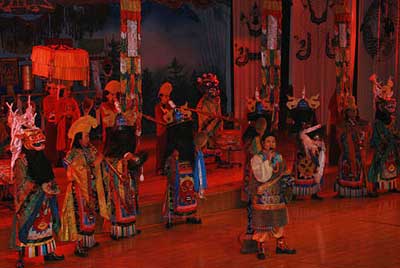
Local Tibetan people in
traditional dress take the stage at the grand theater of the
Sheraton Jiuzhaigou Resort for a performance of Tibetan customs and
religious rituals on January 9, 2008. A dozen such performing
troupes reportedly work in Jiuzhaigou during the prime season.
[Photo: CRIENGLISH.com]
How to Preserve and Promote Tibetan Culture in the Region
Alai, a famous Tibetan writer from Aba and the winner of the
Fifth National Mao Dun Literature Prize, the highest literary award
in China, also attended the Ice Waterfall Tourism Festival.
Alai praised management in Jiuzhaigou for their effective
conservation work. But when it comes to the human aspect, the
writer expressed deep concern. Alai said the issue concerns not
only Jiuzhaigou, but all of the scenic spots in China.
"There is a general trend that, when we talk about culture, we
do not think of it as related to people's lifestyle or livelihoods.
We think of it as ritualistic, like the wedding ceremonies and
funerals, or the styles of singing, dancing and dressing -- these
sort of superficial things. In Jiuzhaigou, they have done very well
by abstracting these things and presenting them to visitors in a
commercialized way."
There are a dozen performance art troupes in Jiuzhaigou, which
stage traditional Tibetan and Qiang rituals in a variety of
performances. This type of performance, called "pure culture" by
the locals, brought in 130 million yuan last year, a striking
figure compared to those of other scenic spots in China.
"The connotation of culture should be widened, considering that
we still have living villages in the scenic valleys. We see at
present that the locals have been changed a lot by tourism. They
have already shifted from farming to offering tourism services, and
have gained considerable economic returns from it. What about
preserving more of the original flavor of the Tibetan culture,
including its architecture and functions? Much has changed, such as
the flashy, over-decorated houses. These aren't necessary at all.
Just present them the way they were."
Alai stressed the importance of exploring the diverse biological
resources. Just a dozen miles away, he said, lies a golden monkey
habitat. The locals have cultivated close relationships with
nature, and it's said that some villagers even have the ability to
summon the monkey. We need to think twice about what "culture"
really means, he said.
But developing tourism always has its pros and cons. Local
officials have realized the problems, and they are not content with
what they have already done. More efforts are being made to improve
the area. But solving the issues is no small task, so that's why
they held the forum to solicit suggestions from experts.
Alai thinks a better tourism model will be key to the area's
future success.
Maybe it is not necessary to sell things for direct economic
returns, he said. It would be profitable in the long term to simply
have people come in and sit, drink some tea, and listen to stories
of the local history.
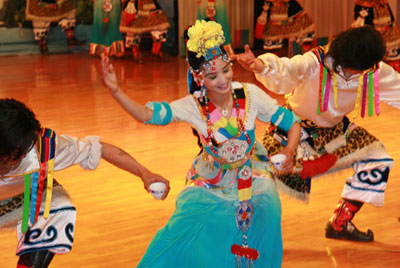
Tibetan performers
entertain the audience on January 9, 2008 during the Fourth Ice
Waterfall Tourism Festival in Jiuzhaigou, Aba Tibetan-Qiang
Autonomous Prefecture, in northeastern Sichuan Province. [Photo:
CRIENGLISH.com]
(CRI January 16, 2008)