Full Text: Report on China's central, local budgets
 0
0 


REPORT ON THE IMPLEMENTATION OF THE CENTRAL AND LOCAL BUDGETS FOR 2009 AND THE DRAFT CENTRAL AND LOCAL BUDGETS FOR 2010
Third Session of the Eleventh National People's Congress March 5, 2010
Ministry of Finance of the People's Republic of China
I. Implementation of the Central and Local Budgets for 2009
II. Draft Central and Local Budgets for 2010
Fellow Deputies,
The Ministry of Finance has been entrusted by the State Council to submit this report on the implementation of the central and local budgets for 2009 and the draft central and local budgets for 2010 for your deliberation and approval, and for the members of the National Committee of the Chinese People's Political Consultative Conference (CPPCC) to provide their comments and suggestions.
I. Implementation of the Central and Local Budgets for 2009
The year 2009 was the most difficult year for our country's economic development since the beginning of the new century. Under the firm leadership of the Communist Party of China (CPC), the people of all our ethnic groups took Deng Xiaoping Theory and the important thought of Three Represents as their guide, thoroughly applied the Scientific Outlook on Development, comprehensively carried out the central leadership's strategic arrangements, conscientiously implemented the pertinent resolution of the Second Session of the Eleventh National People's Congress (NPC), implemented a proactive fiscal policy and a moderately easy monetary policy, comprehensively implemented and constantly enriched and improved the package plan and the policies and measures for responding to the impact of the global financial crisis, and achieved significant new results in reform, opening up and socialist modernization. On this foundation, the central and local budgets were satisfactorily implemented and new progress was made in the reform and development of public finance.
National revenue was 6.847688 trillion yuan, an increase of 714.653 billion yuan or 11.7% over 2008 (here and below). This consisted of 3.589614 trillion yuan collected by the central government and 3.258074 trillion yuan collected by local governments. The central budget stabilization fund contributed 50.5 billion yuan. National expenditures were 7.587364 trillion yuan, an increase of 1.328098 trillion yuan or 21.2%. They consisted of 1.527984 trillion yuan of central government spending and 6.05938 trillion yuan of local government spending. Local government expenditures carried over to 2010 amounted to 260.824 billion yuan. National expenditures exceeded revenue by 950 billion yuan.
Revenue collected by the central government was 3.589614 trillion yuan, 100.1% of the budgeted figure and an increase of 321.558 billion yuan or 9.8%. The central budget stabilization fund contributed 50.5 billion yuan, raising the total revenue used by the central government to 3.640114 trillion yuan. Expenditures of the central government were 4.390114 trillion yuan, 100.1% of the budgeted figure and an increase of 851.258 billion yuan or 24.1%. They consisted of 1.527984 trillion yuan of central government spending, an increase of 14.5%, and 2.86213 trillion yuan of tax rebates and transfer payments to local governments, up 29.8%. Central government expenditures exceeded revenue, resulting in a budget deficit of 750 billion yuan, which was the budgeted figure. The outstanding balance on government bonds in the central budget at the end of 2009 was 6.023768 trillion yuan, which was under budgeted ceiling of 6.270835 trillion yuan for the year.
Central government tax rebates and transfer payments made to local governments. In 2009, central government tax rebates and transfer payments made to local governments totaled 2.86213 trillion yuan, 99.1% of the budgeted figure. This discrepancy was mainly due to less spending on disaster relief than estimated at the beginning of the year, resulting in a decrease in transfer payments. This total consisted of 494.227 billion yuan of tax rebates, an increase of 48.2%, with the increases coming mainly from implementation of the reform of taxes and fees on refined oil products (according to regulations, the central government is required to rebate increases in sales tax on refined oil products to local governments); 1.131989 trillion yuan of general transfer payments, an increase of 29.4%; 1.235914 trillion yuan of special transfer payments, an increase of 24.1%, the majority of which consisted of increased central government spending for investment and stimulating consumption, which was provided to local governments in the form of subsidies. A total of 39.1% of local government spending came from central government transfer payments.
Figure 1 Balance of Central Government Finances in 2009
Billions of yuan

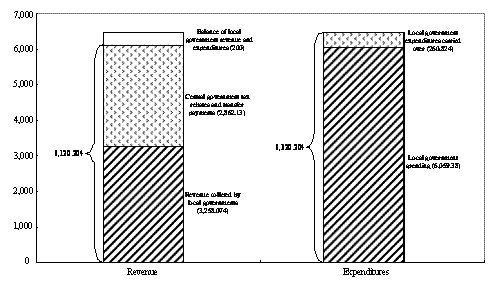
Revenue of local governments was 6.120204 trillion yuan, an increase of 1.050786 trillion yuan or 20.7%. This consisted of 3.258074 trillion yuan collected by local governments, amounting to 53.2% of total revenue, and 2.86213 trillion yuan of tax rebates and transfer payments from the central government, amounting to 46.8% of total revenue. Local government expenditures were 6.05938 trillion yuan, an increase of 1.134531 trillion yuan or 23%. Local government expenditures carried over to 2010 (mainly because some of the money was not used for its intended purposes in 2009, and a portion of the funds will be used this year for the same purposes) amounted to 260.824 billion yuan. Expenditures exceeded revenue by 200 billion yuan. With the approval of the State Council, the Ministry of Finance offset this shortfall by issuing local government bonds on behalf of local governments.
Figure 2 Balance of Local Government Finances in 2009
Billions of yuan
The following is an overview of the major issues in the implementation of the budgets in 2009:
1. Fiscal revenue of the central government
It was more difficult in 2009 than in any other recent year to reach the budgeted figure for fiscal revenue. Financial departments at all levels as well as tax and customs departments resolutely implemented the decisions and arrangements of the central leadership, conscientiously carried out a proactive fiscal policy, energetically promoted steady and rapid economic development, and laid a foundation for increasing revenue. At the same time, they genuinely made fiscal management more scientific and meticulous, strictly collected and managed revenue in accordance with the law, adopted measures to increase revenue such as adjusting the sales tax on tobacco products and pursuing taxpayers with unpaid tax bills from previous years, and ensured they reached their budgeted revenue targets for the year.
Main sources of revenue in the central budget. Domestic VAT revenue was 1.391599 trillion yuan, 95.6% of the budgeted figure and an increase of 3.1%. The shortfall was mainly due to decreased revenue from a decline in producer prices of manufactured goods. Domestic sales tax revenue was 475.912 billion yuan, 107.3% of the budgeted figure and an increase of 85.3%. Surplus revenue derived mainly from increasing tax rates on tobacco products during implementation of the budget. Revenue from VAT and sales tax on imports was 772.915 billion yuan, 96.7% of the budgeted figure and an increase of 4.6%. Revenue from customs duties was 148.357 billion yuan, 78.1% of the budgeted figure and a decrease of 16.2%. The main reason for this shortfall was that the total volume of imports fell considerably short of predictions. VAT and sales tax rebates on exports amounted to 648.656 billion yuan (which represents a decrease in revenue by the same amount), 96.7% of the budgeted figure and an increase of 10.6%. The main reason for this shortfall was that the total volume of exports fell considerably short of predictions. Corporate income tax revenue was 761.882 billion yuan, 100.2% of the budgeted figure and an increase of 6.2%. Personal income tax revenue was 236.672 billion yuan, 99% of the budgeted figure and an increase of 5.9%. Revenue from stamp tax on securities transactions was 49.504 billion yuan, 202.1% of the budgeted figure and a decrease of 47.9%. Revenue from this source exceeded the budgeted figure because securities transactions exceeded expectations. Revenue from vehicle purchase tax was 116.317 billion yuan, 119.9% of the budgeted figure and an increase of 17.5%, mainly due to the rapid increase in sales of motor vehicles. Non-tax revenue was 253.666 billion yuan, 123.6% of the budgeted figure and an increase of 48.2%. This increase was mainly attributable to the collection of back taxes owed by enterprises for special surcharges on oil sales.
Figure 3 Central Government Revenue in 2009

2. Main expenditures in the central budget
In accordance with the decisions and arrangements of the central leadership, the 2009 budget called for further improving the structure of expenditures, and increasing spending on agriculture, education, medical and health care, social security, employment, low-income housing, science and technology, and environmental protection. In the course of implementing the budget, reserve funds were also used mainly in the aforementioned areas, thereby providing assurances for important expenditures, including central government spending and transfer payments to local governments.
1) Total spending on agriculture, forests, and water conservancy came to 350.124 billion yuan, 101.6% of the budgeted figure and an increase of 79.293 billion yuan or 29.3%. This sum consisted of 31.869 billion yuan of central government spending and 318.255 billion yuan of transfer payments to local governments. We improved the dynamic mechanism for adjusting general subsidies for agricultural supplies and provided subsidies for superior varieties of rice, wheat, corn and cotton throughout the country; provided subsidies for superior varieties of soybeans throughout the northeast and initiated trials of subsidies for growing potatoes using pre-elite seeds; and provided subsidies for purchasing agricultural machinery and tools in all farming and herding counties of the country. Spending on these subsidies amounted to 112.35 billion yuan. We extended the scope of subsidies for conducting soil testing to determine appropriate fertilizer formulas to all farming counties in the country. We used 6.5 billion yuan to promote the development of modern agriculture. We spent 16.5 billion yuan on comprehensively developing agriculture, including the upgrading of low- and medium-yield cropland, developing 1.773 million hectares of high-grade cropland, and increasing overall grain production capacity by 3.273 million tons. Subsidies to cover the costs of agricultural insurance amounted to 5.97 billion yuan, and 127 million farming households bought agricultural insurance policies. We implemented a poverty alleviation policy for all low-income rural residents, and raised the levels of assistance. Altogether 19.73 billion yuan in subsidies was disbursed to 40.07 million recipients. We spent 116.87 billion yuan on improving infrastructure for rural areas and agriculture. Considerable support was given to the South-to-North Water Diversion Project and other major water conservancy projects. We reinforced 3,970 large and medium-sized reservoirs and dilapidated key small reservoirs. Some 60.69 million rural residents benefited from the Rural Water Safety Project. The area of national public forests funded by the central government through the forest ecological conservation fund was expanded to 69.93 million hectares.
2) Total expenditures on education amounted to 198.139 billion yuan, 100% of the budgeted figure and an increase of 37.769 billion yuan or 23.6%. This sum consisted of 56.762 billion yuan in central government spending and 141.377 billion yuan of transfer payments to local governments. A total of 66.61 billion yuan was spent on reforming the system for guaranteeing the costs of rural compulsory education. All of the country's approximately 150 million rural students were exempted from paying tuition and miscellaneous fees and supplied with free textbooks. In the central and western regions, around 11.2 million rural students receiving compulsory education whose families have financial difficulties received subsidies enabling them to live in school dormitories. Urban students receiving compulsory education were exempted from paying tuition and miscellaneous fees. The central government supported cities in solving the problem of providing education to 8.8 million children of rural migrant workers, and provided 5.17 billion yuan in subsidies so that children who met local government conditions for school enrollment were exempted from paying tuition, miscellaneous fees, and non-resident surcharges. The policy to link the pay of compulsory education teachers with their performance was steadily implemented. We launched the national project to make primary and secondary school buildings safe, and spent 8 billion yuan on renovating 120 million square meters of school buildings. We spent 1.13 billion yuan on the construction of vocational education training facilities. We exempted tuition for approximately 4.26 million rural students in secondary vocational schools whose families have financial difficulties and students who are studying agriculture-related majors, and provided 2.4 billion yuan in subsidies to cover these costs. A total of 16.23 billion yuan was spent on providing government scholarships and grants to about 4.7 million college students and 11.2 million secondary vocational school students who are outstanding both academically and morally and whose families have financial difficulties. Beginning on September 1, 2009, the standard ordinary scholarship for PhD students at central government institutions of higher learning was raised from 240-280 yuan per month to 1,000 yuan per month. We launched a pilot project to reduce the debt burden of central government institutions of higher learning and provided 10.3 billion yuan for that purpose. We spent 42 billion yuan on the 211 Project and other projects to promote the development of higher education.
3) Expenditures on medical and health care reached 127.714 billion yuan, 108.2% of the budgeted figure and an increase of 42.269 billion yuan or 49.5%. The over-budget amount was mainly concentrated on community-based medical and health care. This sum consisted of 6.35 billion yuan of central government spending and 121.364 billion yuan of transfer payments to local governments. The central government spent 116.2 billion yuan on supporting the reform of the pharmaceutical and healthcare systems. A total of 830 million people were covered by the new type of rural cooperative medical care system, and 180 million urban residents participated in the basic medical insurance system for non-working urban residents, with subsidies reaching 80 yuan per person. We supported retirees from closed or bankrupt state-owned enterprises who were not covered by medical insurance in subscribing to basic health insurance for local urban workers. We increased medical assistance in both urban and rural areas, and provided financial assistance for urban and rural residents experiencing financial hardship to enable them to subscribe to medical insurance and reduce their burden of medical expenses. We implemented a system for basic drugs in 30% of community-level medical institutions. We improved the community-based medical and health service system, and supported the construction of 29,000 hospitals and 5,000 central hospitals in towns and townships. We set up a sound mechanism for guaranteeing funding for basic public health services in urban and rural areas, and implemented major public health service programs.
4) Expenditures on social security and employment work amounted to 329.666 billion yuan, 98.4% of the budgeted figure and an increase of 55.307 billion yuan or 20.2%. The surplus was mainly from less spending on disaster relief than the budgeted figure at the beginning of 2009. This sum consisted of 45.436 billion yuan of central government spending and 284.23 billion yuan of transfer payments to local governments. Expenditures on social security came to 290.575 billion yuan, an increase of 41.424 billion yuan or 16.6%. Trials of the new old-age insurance system for rural residents were carried out in 320 counties. Subsistence allowances for urban and rural residents increased by 15 and 10 yuan per month per person respectively, with total expenditures of 54.085 billion yuan. We provided one-off living allowances to over 75.7 million poverty-stricken people in urban and rural areas throughout the country, with expenditures of 9.067 billion yuan. We provided 132.629 billion yuan for old-age pension funds of enterprises, launched pilot projects to fully fund enterprise employees' personal accounts for basic old-age pensions, continued to raise basic pension benefits for enterprise retirees with a focus on special groups, and established a system of basic old-age insurance at the provincial level throughout the country. We increased allowances for entitled groups, bringing total allowances to 17.3 billion yuan.
We implemented a stronger employment policy. Spending on employment work was 39.091 billion yuan (adding spending on employment work listed in other items to this figure, total spending reached 42.621 billion yuan), an increase of 13.883 billion yuan or 55.1%. We substituted work for relief through government financing of public works projects. We helped enterprises with financial difficulties to keep their employment levels stable by allowing them to postpone their payments of contributions to five types of social security for a set period of time, including contributions to basic old-age pensions, and temporarily reduced their contributions to four types of insurance, including unemployment insurance. We continued to implement tax support policies for laid-off workers to become self-employed and for enterprises to provide employment opportunities to laid-off workers. We instituted the policies of reimbursing tuition and granting state education assistance loans to promote the employment of college graduates. We introduced preferential policies for key enterprises and research projects to absorb college graduates in order to keep their employment stable. We improved the employment assistance system for college graduates who have difficulty finding jobs. We launched special vocational training programs for the urban unemployed and 21 million rural migrant workers who had returned to their villages.
5) Expenditures on low-income housing amounted to 55.056 billion yuan, 111.7% of the budgeted figure and an increase of 36.866 billion yuan or 202.7%. Excess spending was mainly due to greater financial support for the construction of low-income housing. This amount consisted of 2.643 billion yuan of central government spending and 52.413 billion yuan of transfer payments to local governments. A total of 33 billion yuan was used to raise the level of investment subsidies to local governments for building low-rent housing, and intensify the construction of low-rent housing and other low-income housing to solve the housing problems of 2.6 million low-income urban families. We spent 10 billion yuan on accelerating the renovation of run-down areas in state-owned forest regions and land reclamation zones and around coalmines, and helping to solve the housing problems of 1.3 million households. We spent 2.3 billion yuan to carry forward the project to build permanent housing for nomads in ethnic minority areas, and provided 92,000 families with permanent homes. We provided 4 billion yuan in subsidies for expanding pilot projects to renovate dilapidated rural houses to more areas, which benefited 800,000 households.
6) Expenditures on culture, sports, and mass media totaled 32.073 billion yuan, 114.6% of the budgeted figure and an increase of 6.792 billion yuan or 26.9%. Excess spending was largely on public culture in rural areas. This total consisted of 15.475 billion yuan of central government spending and 16.598 billion yuan of transfer payments to local governments. We vigorously developed non-profit cultural programs and supported free admission to museums, memorial halls, and national patriotic education demonstration centers. The central government granted subsidies to 1,444 museums and memorial halls for this purpose. Implementation of key cultural projects that benefit the people, such as rural reading rooms and the extension of radio and television coverage to all villages, progressed smoothly. We strengthened the protection of major cultural and historical sites, key cultural relics, and our intangible cultural heritage.
7) Expenditures on the reserves of grain, edible oil, and other materials totaled 174.662 billion yuan, 98.1% of the budgeted figure and an increase of 64.789 billion yuan or 59%. This total consisted of 80.543 billion yuan of central government spending and 94.119 billion yuan of transfer payments to local governments. We provided 15.1 billion yuan in ongoing direct subsidies to grain growers. A total of 72.119 billion yuan was used to strengthen the reserves system to gradually increase the grain and edible oil reserves of the central government and its temporary grain and edible oil reserves, and also to increase the reserves of important materials including nonferrous metals and special steel products by 2.49 million tons. We supported significant increases in minimum grain purchase prices, and spent 9.9 billion yuan to subsidize related interest and expenses. We disbursed 32 billion yuan in subsidies implementing the policy to encourage rural residents to purchase home appliances and motor vehicles including motorbikes and consumers to trade-in old home appliances and motor vehicles for new ones. We used 7.6 billion yuan to promote the development of the logistics services industry and improve the rural logistics system.
8) Expenditures on science and technology came to 151.202 billion yuan, 103.5% of the budgeted figure and an increase of 34.879 billion yuan or 30%. This figure consisted of 143.385 billion yuan of central government spending and 7.817 billion yuan of transfer payments to local governments. We spent 94.676 billion yuan on intensifying basic and applied research, and 32.8 billion yuan on accelerating the development of major science and technology projects. We disbursed 20 billion yuan in technological innovation funds to implement the plan for restructuring and invigorating ten key industries, support 4,441 technological upgrading projects, and promote technological upgrading and independent innovation in enterprises. We promoted the development of regional scientific and technological innovation systems and the intimate integration of enterprises, universities, research institutes, and end-users.
9) Expenditures on environmental protection came to 115.18 billion yuan, 93.1% of the budgeted figure and an increase of 11.15 billion yuan or 10.7%. Spending was less than the budgeted figure mainly because the subsidies actually paid out for returning farmland to forests were less than forecast. This sum consisted of 3.79 billion yuan of central government spending and 111.39 billion yuan of transfer payments to local governments. A total of 56.747 billion yuan was spent on encouraging energy conservation and emissions reductions, supporting 1,318 key energy-saving projects and 132 key recycling and resource conservation projects, and helping 1,116 enterprises to retrofit energy-conserving technology. We constantly improved our environmental monitoring capabilities, and helped standardize 497 environmental monitoring stations and 617 environmental oversight and law enforcement bodies. We carried out 1,049 projects in the course of implementing major programs for reducing pollution, including the prevention and control of water pollution in key watersheds. We supported the construction of 13,800 kilometers of pipelines for urban sewage treatment systems. We implemented a project to promote products that conserve energy and benefit the people, and put more than 5 million energy-saving air-conditioners and 150 million energy-efficient light bulbs into use. We increased the application of high-efficiency, energy-conserving products and motor vehicles powered by new energy sources. We spent 7.679 billion yuan on accelerating the development of renewable energy. We pushed forward the implementation of the Golden Sun Project and developed the photovoltaic industry. We promoted the development of biomass energy and wind power. We used 46.636 billion yuan to protect virgin forests, consolidate progress already made in returning farmland to forests, and conserve grasslands. We improved all aspects of the environment in 1,465 villages in order to make them ecological conservation models.
10) Expenditures on public security amounted to 128.745 billion yuan, 110.9% of the budgeted figure and an increase of 41.441 billion yuan or 47.5%. The excess consisted mainly of increased expenses for equipment and operation of procuratorial, judicial, and public security departments. This sum consisted of 84.579 billion yuan of central government spending and 44.166 billion yuan of transfer payments to local governments. We reformed the funding mechanism for procuratorial, judicial, and public security departments; increased financial assistance for local procuratorial, judicial, and public security departments, especially those at the county level in the central and western regions; and enhanced their ability to perform their functions. We continued to intensify efforts to informationize procuratorial, judicial, and public security departments, and the People's Armed Police Force.
11) Expenditures on post-Wenchuan earthquake recovery and reconstruction reached 96.999 billion yuan (excluding the money appropriated for this purpose out of vehicle purchase tax revenue and lottery ticket proceeds), which was 100% of the budgeted figure. This figure consisted of 13.06 billion yuan of central government spending and 83.939 billion yuan of transfer payments to local governments. In accordance with plans, these funds were used in the areas of housing, infrastructure, public services, industrial rebuilding, and improvement of the ecosystem.
12) National defense spending came to 482.985 billion yuan, 102.1% of the budgeted figure and an increase of 72.844 billion yuan or 17.8%. This amount consisted of 482.501 billion yuan of central government spending and 484 million yuan of transfer payments to local governments. These funds were used to improve the living conditions and benefits of army officers and enlisted personnel, intensify the development of informationization, increase the army's equipment and supporting facilities by an appropriate amount, and improve its ability to respond to emergencies and disasters.
13) Expenditures on transportation and transport amounted to 217.871 billion yuan, 115.4% of the budgeted figure and an increase of 60.677 billion yuan or 38.6%. The excess consisted mainly of increased spending on highway construction resulting from unexpectedly high vehicle sales tax revenue, which is required by regulations to be spent for this purpose. This sum consisted of 106.918 billion yuan of central government spending and 110.953 billion yuan of transfer payments to local governments. We spent 76.51 billion yuan on the construction of the expressway network and passenger railway lines nationwide, and trunk railway lines in the western region. Another 62 billion yuan was used to increase subsidies for the construction of rural highways in ethnic minority, border, and poverty-stricken areas in the central and western regions, and support the construction or upgrading of 380,000 kilometers of rural highways. We spent 10.5 billion yuan of fuel purchase subsidies for some public service sectors, such as urban public transport and rural passenger transport. We spent 26 billion yuan on subsidies to local governments for phasing out tolls on government-financed Grade II highways, and spent 6.1 billion yuan on improving postal services.
14) Expenditures on general public services came to 132.663 billion yuan, 101% of the budgeted figure and an increase of 11.145 billion yuan or 9.2%. This consisted of 108.422 billion yuan of central government spending and 24.241 billion yuan of transfer payments to local governments. These funds were used mainly to ensure the normal operation of government offices and assist local governments in providing severance packages to personnel leaving the armed services to find other employment.
15. Expenditures on interest on government bonds amounted to 132.07 billion yuan, 96.3% of the budgeted figure and an increase of 4.201 billion yuan or 3.3%.
Figure 4 Central Government Expenditures in 2009

Central government expenditures on the above items in areas that directly affect the people's lives such as education, medical and health care, social security, employment, low-income housing, and culture totaled 742.648 billion yuan, an increase of 31.8%. This sum is even larger if we include central government expenditures on environmental protection, transportation and transport, which also affect people's lives. Central government expenditures on agriculture, rural areas, and farmers totaled 725.31 billion yuan, up 21.8%. This figure included 267.92 billion yuan for agricultural production; 127.45 billion yuan for direct subsidies to grain growers, general subsidies for purchasing agricultural supplies, and subsidies for purchasing superior crop varieties and agricultural machinery and tools; 272.32 billion yuan for social programs such as education and health in rural areas; and 57.62 billion yuan for expenses and interest related to reserves of agricultural products. A large proportion of the central government's tax rebates and general transfer payments to local governments were also used to improve people's wellbeing and benefit agriculture, rural areas, and farmers.
3. Revenue and expenditures from government-managed funds
In 2009, revenue from government-managed funds nationwide was 1.833504 trillion yuan, and expenditures amounted to 1.611879 trillion yuan. This broke down as follows:
Revenue from central government-managed funds reached 250.767 billion yuan, 108.8% of the budgeted figure and an increase of 82 million yuan. The majority of the surplus revenue came from compensation for the use of land newly designated for development and lottery ticket proceeds. Total revenue included 19.598 billion yuan from the Three Gorges Project construction fund, 54.411 billion yuan from the railroad construction fund, 11.499 billion yuan from civilian airport administration and development fees, 10.555 billion yuan from port development fees, 27.494 billion yuan from compensation for the use of land newly designated for development, 15.882 billion yuan from the fund for providing continuing aid to residents relocated to make way for the construction of large and medium-sized reservoirs, and 20.117 billion yuan from lottery ticket proceeds. Adding the 57.458 billion yuan carried over from 2008, total revenue came to 308.225 billion yuan. Expenditures from central government-managed funds totaled 242.654 billion yuan, 84.2% of the budgeted figure and down 3.2%, with this decrease primarily attributable to carrying over from last year a portion of compensation for the use of land newly designated for development and the fund for providing continuing aid to residents relocated to make way for the construction of large and medium-sized reservoirs. This included 19.923 billion yuan from the Three Gorges Project construction fund, 54.411 billion yuan from the railroad construction fund, 11.014 billion yuan from civilian airport administration and development fees, 10.22 billion yuan from port development fees, 19.811 billion yuan in expenditures related to land newly designated for development, 15.114 billion yuan from the fund for providing continuing aid to residents relocated to make way for the construction of large and medium-sized reservoirs, and 20.79 billion yuan from lottery ticket proceeds spent on social welfare programs, sports, education and other public service programs. A total of 65.571 billion yuan was carried over to 2010 from central government-managed funds.
Revenue collected by local governments from funds under their control reached 1.582737 trillion yuan, including 1.396476 trillion yuan of revenue from the transfer of state-owned land-use rights, which consists the fees for the transfer of these rights, income of the state-owned land income fund and the agricultural land development fund, and compensation for the use of land newly designated for development; 21.175 billion yuan from lottery ticket proceeds; 33.66 billion yuan from urban infrastructure construction fees; and 17.844 billion yuan from local education surcharges. Expenditures from local government-managed funds totaled 1.429155 trillion yuan. This included 1.23271 trillion yuan in revenue from the transfer of state-owned land-use rights, consisting of 518.058 billion yuan in compensation for land expropriation, housing demolition and resident relocation, and subsidies to farmers whose land was expropriated; 142.971 billion yuan for developing land; 43.31 billion yuan for strengthening rural infrastructure; 334.099 billion yuan for promoting urban development; 47.756 billion yuan for improving land and developing arable land; 8.689 billion yuan for transferring land; and 137.827 billion yuan for low-rent housing, and for assisting laid-off employees of state-owned enterprises that went bankrupt or were converted into joint stock companies using income from those enterprises' land. A total of 23.147 billion yuan from lottery ticket proceeds was spent on social welfare programs, sports, education and other public service programs; 21.469 billion yuan was spent on urban infrastructure construction; and 12.883 billion yuan went to local education programs.
In 2009, the discrepancy between revenue and expenditures from these funds arose primarily because revenue was used exclusively for its intended purposes and a portion of it was carried over to this year in accordance with fund management regulations.
4. Implementation of a proactive fiscal policy
We worked hard to counter the impact of the global financial crisis; took maintaining steady and rapid economic development as the top priority of our fiscal work; made full use of the role of public finance; implemented a proactive fiscal policy; used a full range of policy tools such as budgets, government bonds, and taxes; maintained an appropriate intensity and pace of policy implementation; did all we could to boost domestic demand; ensured and improved people's wellbeing; pushed ahead with economic restructuring; and encouraged the turnaround of the economy.
We increased government investment and intensified the development of key areas. On the basis of overall plans for the use of public finance budget funds, revenue from government-managed funds, and income from the operations of state capital, the central government spent a total of 924.3 billion yuan on investment, 101.8% of the budgeted figure and an increase of 503.8 billion yuan over the budgeted figure of the previous year. This total included 256.7 billion yuan for developing agricultural infrastructure and improving rural residents' lives; 96.5 billion yuan for promoting education, health care, and other social programs; 55.1 billion yuan for building low-income housing; 77.7 billion yuan for conserving energy, reducing emissions, and improving ecosystems; 68.1 billion yuan for funding independent innovation, technological upgrading, and the service sector; 215.1 billion yuan for developing major infrastructure facilities; and 130.5 billion yuan for financing post-Wenchuan earthquake recovery and reconstruction. We strengthened the unified leadership, supervision, and inspection of central government investment to ensure it was used effectively in accordance with regulations. We issued 200 billion yuan of bonds for local governments to finance their associated expenditures. These investments increased immediate demand, stimulated non-government investment and consumer spending, and shored up weak links in economic and social development.
We optimized the taxation system and carried out structural tax reductions. We introduced VAT on consumer products across the country, adjusted the criteria for classifying small-scale VAT payers, and lowered their rate of VAT to encourage enterprises to invest more in independent innovation and technological upgrading. We carried out the reform of taxes and fees on refined oil products to make the tax burden equitable and promote energy conservation and emissions reductions. The sales tax rate for passenger vehicles with engine displacement of 1.6 liters or less was temporarily reduced to 5%. The export tax rebate rates for textiles, garments, petrochemicals, electronic information, and other products were lowered four times, and the import and export tariffs on some commodities were adjusted many times. One hundred administrative fees were either rescinded or suspended. Implementation of the existing tax reduction and exemption policies was continued. All together, these policies on tax and fee reductions and exemptions reduced the burden of businesses and individuals by about 500 billion yuan and thereby helped expand corporate investment and stimulate individual consumption.
We increased the incomes of both urban and rural residents and strengthened their consumption capacity. We further increased subsidies for farmers and significantly raised the minimum purchase prices of grain to increase farmers' incomes. We raised allowances for urban and rural recipients of subsistence allowances, enterprise retirees, and entitled groups. We implemented the policies of subsidizing the sale of home appliances and motor vehicles including motorbikes in the countryside and getting consumers to trade-in old motor vehicles and home appliances for new ones. We also constantly improved our operational methods so that government subsidies were used more effectively. Preliminary statistics show that 34.5 million home appliances were sold at subsidized prices in the countryside.
5. Progress in fiscal, taxation, and related reforms
We comprehensively implemented VAT reform, eliminated instances of duplicate tax charges and optimized the taxation system. We proceeded smoothly with the reform of taxes and fees on refined oil products, clarifying what these taxes and fees are, standardized government fee collection practices, and established an effective long-term mechanism for raising highway construction funds and a new mechanism for using tax policy to guide energy consumption. We improved policies on the implementation of the Law on Corporate Income Tax. We comprehensively implemented the revised Provisional Regulations on Business Tax and the detailed rules for implementing them, and improved business tax policies. We adjusted the sales tax policy on tobacco products. We unified real estate tax regulations for domestic and overseas-funded enterprises and Chinese and foreign nationals. We improved the system of transfer payments to ethnic minority areas as well as the methods for making transfer payments to cities once dependent on now-depleted mineral resources and to major functional ecological zones. We explored ways to create a mechanism to ensure basic funding for county-level governments, and steadily carried forward the reform to place county finances directly under the management of provincial governments. We deepened the reform of the budget management system, and continued to push ahead with reforms of the systems for departmental budgeting, centralized treasury collection and payment, and government procurement. We instituted the reform of tenure in collective forests throughout the country. We helped 14 selected provincial-level administrative areas repay 49.3 billion yuan of debts incurred in providing nine-year compulsory education in rural areas. The trial of a government award and subsidy system for village-level public works projects, the launching of which will be determined by the villagers through deliberation, was expanded to 17 provincial-level administrative areas, resulting in investment exceeding 60 billion yuan and benefits for 260 million farmers.
6. Implementation of the NPC resolution on budgets
In accordance with the pertinent resolution of the Second Session of the Eleventh NPC and the guidelines of the Financial and Economic Affairs Commission of the NPC, we diligently implemented the policies on reforming taxes and fees, and strengthened the collection and management of revenue; implemented policies benefiting agriculture, rural areas, and farmers, and made good use of funds supporting them; worked hard to ensure and improve people's wellbeing; raised the performance of government investment; and pushed ahead with the reform of the public finance system. We made management of public finance more scientific and meticulous. We made substantial progress in revising the Budget Law, promulgated and implemented the Regulations on Lottery Management, and made continued progress in improving public finance legislation. We researched ways to set up a complete government budget system, further improved the system for managing the budgets of government-managed funds and the budget system for state capital operations, and started to compile budgets for social security funds on a trial basis. Budgetary spending was implemented more quickly, and implementation of the budget gradually became more balanced and efficient. We carried out a special examination of the budget for the appropriation of new assets, and intimately integrated asset management and budgetary management. The pilot program to assess the performance of budgetary spending in departments of the central government was expanded from 108 items in 74 departments in 2008 to 167 items in 94 departments last year. We created sound regulations and policies for managing fees and funds are deposited, put administrative and institutional fees collected by national and central government departments and institutions under budgetary management, and comprehensively carried out reform of non-tax revenue collection and management. We continued to improve the system of standards for employee quotas and fixed funding for basic expenditures, steadily advanced the pilot project for setting spending levels of departments on the basis of their assets, and accelerated the development of a system of standards for setting expenditure levels for programs. We reviewed programs and intensified work on creating a program database. We strengthened local public finances to guarantee the effective implementation of policies for ensuring people's wellbeing. We intensified oversight and inspection of public finance, with the focus on monitoring the use of funds and increasing oversight of the implementation of policies for boosting domestic demand and promoting economic growth. We urged local governments to accelerate the implementation of the central government investment budget, and ensured safe and efficient use of budgetary funds. We continued to informationize public finance and strengthen basic supervision of accounting and related work. We worked harder to make the administration of government finances more open, and gradually increased the timeliness and transparency of this work. We closely monitored and controlled debts owed by corporations to local financing platforms, and worked out policies and measures to effectively guard against risk from local government debts. A new stage was reached in controlling unauthorized departmental coffers.
The new achievements in budget implementation and other fiscal work in 2009 would not have been possible without the scientific decision making and firm leadership of the CPC Central Committee and the State Council; the oversight, guidance, and staunch support of the NPC and the CPPCC National Committee; and the close collaboration and hard work of all localities and departments. Nevertheless, we are keenly aware that serious problems concerning fiscal operations and management still exist. The structure of revenue growth is not sufficiently balanced, and funding for ensuring people's wellbeing needs to be increased. The system of departmental budgets needs to improve, and budgetary expenditures need to be implemented at a more balanced pace. Local government debts are mounting and financial risks cannot be overlooked. The transfer payment system is not yet sufficiently standardized; fiscal systems at and below the provincial level need to further improve, and township- and county-level governments in some areas are experiencing financial difficulties. Fiscal management remains fairly weak and there is an urgent need for the performance of government funds to improve. We will pay close attention to these problems and continue to adopt measures to solve them.


