Full Text: Report on China's central, local budgets
 0 Comment(s)
 Print
Print E-mail China.org.cn, March 14, 2012


Contents
I. IMPLEMENTATION OF CENTRAL AND LOCAL BUDGETS FOR 2011
II. DRAFT CENTRAL AND LOCAL BUDGETS FOR 2012
II. DRAFT CENTRAL AND LOCAL BUDGETS FOR 2012
1. Current Fiscal and Economic Situations Facing China
Our country's economic development faces a more complex situation in 2012, and there will be a significant imbalance between revenue and expenditure.
Regarding revenue, sustained economic growth will lay a strong foundation for revenue growth. However, many uncertainties exist in the global and domestic economic situations, growth in corporate profits will fall, structural tax reductions will be increased, and a higher individual income tax threshold on salaries and adjustments to the tax rate structure will both have a lingering effect on this year's revenue. We will carry out pilot reforms of replacing business tax with VAT, raise the income threshold on special surcharges on oil sales, and extend and expand the preferential income tax policy for small businesses with low profits. Add to this the higher VAT and business tax thresholds implemented last year, and the result is that revenue will fall this year.
As for expenditure, government spending on education needs to be expanded, and considerable increases in government investment are needed to extend coverage of the new old-age insurance system to all eligible yet uninsured rural and urban residents, to increase basic pensions for enterprise retirees and government subsidies to the new rural cooperative medical care system and the basic medical insurance system for non-working urban residents, and to increase investment in low-income housing projects. All these efforts will put great pressure on expenditure.
2. General Requirements for Compiling Budgets and Doing Public Finance Work
On the basis of the central leadership's decisions and arrangements, while compiling the 2012 budgets and doing public finance work, we will comprehensively implement the guiding principles of the Seventeenth CPC National Congress, the third through sixth plenary sessions of the Seventeenth Central Committee, and the Central Economic Work Conference; take Deng Xiaoping Theory and the important thought of Three Represents as our guide; thoroughly apply the Scientific Outlook on Development; keep in mind the theme of scientific development and the main thread of accelerating the transformation of the pattern of economic development; and adhere to the general principle of making progress while maintaining stability in all aspects of our work. We need to follow a proactive fiscal policy; deepen reform of fiscal and tax systems; improve structural tax cut policies; adjust the distribution of national income; further optimize the structure of government spending; increase support for agriculture, rural areas, farmers, education, medical and health care, social security, employment, culture, low-income housing, energy conservation, environmental protection, and underdeveloped areas; strictly limit regular expenditures; and maintain and improve living standards. We need to adhere to the principles of managing fiscal matters in accordance with the law, taking all factors into consideration when making overall plans, and increasing revenue and reducing expenditure; manage public finances in a more scientific manner; use government funds more efficiently; push forward economic restructuring and balanced regional development; promote steady and robust economic development; keep overall price levels basically stable; and maintain social harmony and stability, so we can greet the coming Eighteenth National Party Congress with outstanding achievements in economic and social development.
In following a proactive fiscal policy, we must focus on the following areas.
First, we need to improve structural tax cut policies to reduce the burden on businesses and consumers. We will enforce the revised Law on Individual Income Tax, and implement the policy of raising VAT and business tax thresholds and other policies designed to relieve the tax and fee burden on small and micro businesses. We will implement a preferential policy to halve the income tax on small businesses with low profits. We will carry out pilot projects to replace business tax with VAT, and steadily extend the trials to more areas in order to spur the development of the service sector, particularly the modern service sector. We will reduce tariffs on some imported commodities and increase imports of energy and resource products, advanced equipment, and key parts and components. We will expand trials of a tax on the income of logistics enterprises after deductions, improve the policy on urban land-use tax imposed on land for warehousing major commodities, and eliminate VAT on vegetable wholesalers and retailers, so as to reduce the tax burden on logistics enterprises and those who produce and distribute agricultural products. We will earnestly implement all other tax relief and exemption policies in accordance with the law. We will also review and eliminate some administrative charges on enterprises.
Second, we need to increase people's incomes to boost their purchasing power. We will put into effect a more proactive employment policy, and implement the minimum wage system. We will increase government subsidies to raise the incomes of urban and rural residents, particularly those in low- and middle-income brackets; reduce people's burden of paying for education, medical services, and housing; and increase their purchasing power. We will support the development of goods distribution networks, and create a good consumption environment.
Third, we need to further optimize the structure of government spending to maintain and improve living standards. We need to maintain a large scale of government spending so that we can increase expenditures on ensuring and improving living standards; direct more funds toward the primary level, rural and remote areas, and groups with financial difficulties; and more quickly develop education, medical and health care, social security, employment, low-income housing, public culture, and other social programs. We will optimize the structure of investments to shore up weak links in economic and social development, strictly control new projects to prevent redundant construction, and seriously limit administrative expenses and other regular expenditures to bring down administrative costs.
Fourth, we need to promote economic restructuring and balanced regional development to spur faster transformation of the pattern of economic development. We make full use of the significant role fiscal and tax policies play in economic restructuring, constantly increase government investment, and improve fiscal and tax systems as well as mechanisms that are conducive to transforming the pattern of economic development. We will increase investment in science and technology, optimize the expenditure structure in this area, and support independent innovation and improvements in the core competitiveness of industries. We will push forward energy conservation and emissions reductions, and act more quickly to develop new, renewable, and clean energies. We will establish a sound cap-and-trade policy system for pollution rights. We will extend the policy of subsidizing and rewarding grassland ecological conservation to cover all herding and semi-herding counties designated by the state. We will increase financial support for small and medium-sized enterprises, provide them with tax and fee cuts and exemptions, and encourage them to operate prudently and achieve sustained development. We will vigorously support the development of strategic emerging industries and high-tech industries, promote optimization and upgrading of traditional industries, and stimulate faster development of the modern service industry. We will implement the strategy of using major cultural projects to spur the development of the entire industry. We will put into effect fiscal and tax policies that promote balanced regional development, and enhance the ability of areas with financial difficulties to ensure the implementation of all policies devised to improve people's lives. We will expand trials of key small green cities and towns, and vigorously yet prudently move ahead with urbanization.
Taking all factors into consideration, governments at all levels will concentrate financial resources to accomplish several major tasks aimed at maintaining and improving living standards in 2012. First, we will increase education spending to ensure budgetary expenditure on education nationwide accounts for 4% of GDP. Second, we will accelerate the development of the social security system, and make the new old-age insurance system available to all eligible rural and urban residents. Third, we will deepen reform of the pharmaceutical and healthcare systems, increase government subsidies to the new rural cooperative medical care system and basic medical insurance for non-working urban residents, speed up trial reforms in public hospitals, and make medical services more affordable and accessible. Fourth, we will make steady progress in building low-income housing, begin construction on more than seven million units of housing while completing ongoing projects, and help ease housing difficulties of low-income urban residents, first-time workers, and rural migrant workers. Fifth, we will vigorously promote cultural development and prosperity, and ensure that growth in government spending on cultural development exceeds the regular revenue increase, in order to better satisfy people's cultural needs. Sixth, we will increase policy support to strengthen agriculture, benefit farmers, and make the countryside prosperous; support construction of irrigation and water conservancy facilities and other working and living infrastructure in rural areas; stimulate innovation in agricultural science and technology; and promote increases in agricultural production and farmers' incomes as well as the prosperity of the countryside.
3. Public Finance Budgets for 2012
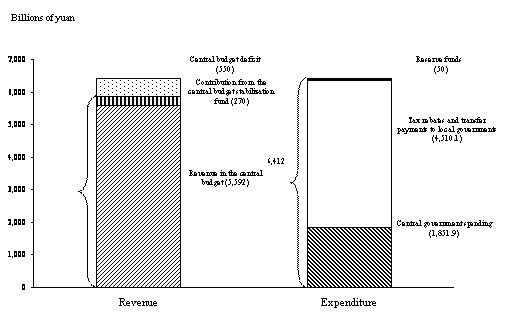
On the basis of the general requirements for compiling budgets as well as the targets for economic and social development in 2012 and economic and social policies decided upon at the Central Economic Work Conference, we have set the following major targets for the 2012 public finance budgets: total central government revenue should reach 5.592 trillion yuan, an increase of 9% over the actual figure for 2011 (here and below). Adding the 270 billion yuan from the central budget stabilization fund, disposable revenue for 2012 should amount to 5.862 trillion yuan. Central government expenditure should total 6.412 trillion yuan, an increase of 13.7%. This consists of 1.8519 trillion yuan incurred at the central level, up 12.1%; 4.5101 trillion yuan paid out as tax rebates and transfer payments to local governments, up 13%; and 50 billion yuan used as reserve funds in the central budget, the same as the budgeted figure for 2011. Expenditure exceeds revenue in the central budget, leaving a deficit of 550 billion yuan, down 100 billion. The ceiling for the outstanding balance on government bonds in the central budget stands at 8.270835 trillion yuan.
Figure 3
Budgetary Balance of Central Government Finances for 2012
Based on preliminary provisions for the local budgets compiled by the central government, revenue collected by local governments will amount to 5.768 trillion yuan, an increase of 10%. Adding the 4.5101 trillion yuan in tax rebates and transfer payments from the central government, local government revenue will total 10.2781 trillion yuan. The central government will issue 250 billion yuan worth of treasury bonds for local governments. Local government expenditure will amount to 10.5281 trillion yuan, up 13.9%. The 50 billion yuan increase in local government bonds to be issued this year is based mainly on the considerations that low-income housing projects need more investment, and ongoing public welfare projects require follow-up investment following the standardization of debt management in financing corporations run by local governments. Revenue and expenditure budgets of local governments are compiled by local people's governments and subject to approval by people's congresses at their respective levels.
Combining central and local budgets, national revenue will be 11.36 trillion yuan, up 9.5%. Including the 270 billion yuan from the central budget stabilization fund, total available national revenue is projected to be 11.63 trillion yuan. Total national expenditure is budgeted at 12.43 trillion yuan, up 14.1%. Total expenditure exceeds total revenue by 800 billion yuan (including the 550 billion yuan central government deficit), 50 billion yuan less than last year and bringing the deficit down to approximately 1.5% of GDP.
1) Main items provided for in the central budget
(1) Main revenue items
On the basis of relevant targets set forth in the plan for national economic and social development, we have considered factors that could increase or reduce revenue due to adjustments in fiscal and tax policies, analyzed and calculated figures for all revenue items, and set the following targets for major revenue items in the 2012 central budget: revenue from domestic VAT will amount to 2.025 trillion yuan, up 10.8%; revenue from domestic excise tax, 770 billion yuan, up 11%; revenue from customs duties as well as VAT and excise tax on imports, 1.7528 trillion yuan, up 8.7%; revenue from corporate income tax, 1.112 trillion yuan, up 11%; revenue from individual income tax, 340 billion yuan, down 6.4%; VAT and excise tax rebates on exports, 995 billion yuan, up 8.1%; and non-tax revenue, 282.6 billion yuan, up 5.6%.
(2) Main expenditure items
In compiling the central expenditure budget, we have further optimized the spending structure. The main expenditure items are arranged as follows.
The appropriation for education is 378.132 billion yuan, an increase of 16.4%. This consists of 102.887 billion yuan of central government spending and 275.245 billion yuan in transfer payments to local governments. We will allocate 15 billion yuan, up 48.1%, in subsidies to implement a host of policies and measures for promoting the development of preschool education, with the focus on the central and western regions and poor areas of the eastern region. We will spend 105.754 billion yuan to improve the mechanism for guaranteeing funding for rural compulsory education, push forward upgrading of weak rural compulsory education schools, implement the plan to attract exemplary teachers to work in rural compulsory education schools and the state programs to train primary and secondary school teachers, and promote balanced development of compulsory education. We plan to disburse 16 billion yuan in rewards and subsidies to carry out an initiative designed to improve the nutrition of rural students attending compulsory education schools in contiguous areas with particular difficulties. We will earmark 8.2 billion yuan to exempt urban compulsory education students from tuition and miscellaneous fees, and make compulsory education equally available to children of rural migrant workers in cities. We will allocate 25.68 billion yuan, up 91.7%, to further strengthen vocational education infrastructure and phase in a system to make secondary vocational education free of charge; 20.697 billion yuan in subsidies to improve the policy system for providing government financial aid to students from poor families; and 135.25 billion yuan, up 24%, to advance Project 985 and Project 211 and support the development of local colleges and universities.
The appropriation for science and technology is 228.546 billion yuan, an increase of 12.4%. This figure consists of 223.44 billion yuan of central government spending and 5.106 billion yuan in transfer payments to local governments. We will further improve the structure of science and technology spending, and highlight support for key areas. We will appropriate 45.6 billion yuan to ensure the implementation of major state science and technology projects. With a total allocation of 32.459 billion yuan, we will increase investment in the State Natural Sciences Fund, and give impetus to capacity building in key state laboratories and basic research institutes. We will disburse 119.39 billion yuan, an increase of 19.7%, to support research on cutting-edge technologies, research for public benefit, and R&D on major generic key technologies. A total of 4.12 billion yuan will be earmarked to strengthen R&D on and industrial application of key industrial technologies and to help enterprises increase their innovation capabilities. We will launch a state seed fund for applying scientific and technological advances to spur their translation into practical productive forces. We will guide the development of local scientific and technological work toward the creation of regional innovation systems with distinctive local features. We will protect intellectual property rights more effectively and promote the development of Chinese intellectual property rights.
The appropriation for culture, sports, and media is 49.384 billion yuan, up 18.7%. This figure consists of 20.733 billion yuan of central government spending and 28.651 billion yuan in transfer payments to local governments. We plan to allocate 14.546 billion yuan to develop the system of public cultural services, support free admission to public cultural facilities such as museums and public libraries, and continue to implement key cultural projects that benefit the people. We will appropriate 6.124 billion yuan, up 40%, to strengthen protection of key national cultural artifacts, major cultural and historical sites, cultural resources related to the early history of the CPC, and intangible cultural heritage; 2.75 billion yuan, up 37.5%, to strengthen the international broadcasting capability of key media and support efforts to take Chinese culture to a global audience; and 3.4 billion yuan, up 70%, to support the development of the culture industry.
The appropriation for medical and health care is 203.505 billion yuan, an increase of 16.4%. This figure consists of 8.331 billion yuan of central government spending and 195.174 billion yuan in transfer payments to local governments. We plan to allocate 105 billion yuan in subsidies, up 37%, to raise government subsidies for the new rural cooperative medical care system and basic medical insurance for non-working urban residents to 240 yuan per person per year, and appropriately increase the proportion of costs that are reimbursable. We will improve the national system of basic drugs, and deepen the comprehensive reform of community-level medical and health care institutions. We will allocate 35.8 billion yuan to improve the mechanism for ensuring funding for delivering basic public health services to rural and urban residents, and continue to implement basic public health programs and prevent and control major communicable diseases such as AIDS and tuberculosis. We will accelerate trial reforms in public hospitals, with particular focus on county-level hospitals. We will support the work of providing medical assistance to rural and urban residents with an appropriation of 11.483 billion yuan.
The appropriation for social security and employment is 575.073 billion yuan, an increase of 21.9%. This figure consists of 57.063 billion yuan of central government spending and 518.01 billion yuan in transfer payments to local governments. We plan to allocate 77.1 billion yuan in subsidies to ensure all eligible rural and urban residents are covered by the new old-age insurance system by July 1 this year. We will earmark 217.373 billion yuan in subsidies to continue to increase basic pension benefits of enterprise retirees and improve the overall planning system for basic retirement pension funds for enterprise employees at the provincial level. We will appropriate 92.888 billion yuan to raise subsistence allowances to a suitable level, with per capita monthly benefits to be increased by 15 and 12 yuan for urban and rural recipients respectively, and to further improve social assistance systems targeted at orphans, people with disabilities, vagrants, and beggars. We will disburse 28.837 billion yuan to raise subsidies and living allowances for entitled groups as needed, 13 billion yuan to guarantee basic living conditions of disaster victims, and 43.917 billion yuan to increase policy support for employment.
The appropriation for guaranteeing adequate housing is 211.755 billion yuan, an increase of 23.1%. This figure consists of 37.44 billion yuan of central government spending and 174.315 billion yuan in transfer payments to local governments. We will appropriate 178.746 billion yuan, an increase of 24.8%, to build low-income housing projects, appropriately expand the scope of dilapidated rural houses eligible for policy-backed renovation and raise the standard of subsidies from the central government, and steadily push forward the construction of permanent housing for nomads.
The appropriation for agriculture, forestry, and water conservancy is 549.145 billion yuan, up 14.8%. This figure consists of 42.744 billion yuan of central government spending and 506.401 billion yuan in transfer payments to local governments. We will advance the construction of small irrigation and water conservancy facilities in key counties, appropriately raise construction and subsidy standards, and intensify efforts to harness small and medium-sized rivers, reinforce dangerously defective small reservoirs, and prevent and control geological disasters due to mountain torrents. Altogether, allocations for agricultural and rural infrastructure development stand at 165.446 billion yuan. We will appropriate 169.338 billion yuan to improve the policy on subsidies for superior crop varieties, scale up general subsidies for agricultural supplies and subsidies for the purchase of agricultural machinery, increase the areas and crop varieties eligible for subsidies on agricultural insurance premiums, and further increase subsidies for afforestation. We will earmark 10.1 billion yuan, up 53%, to increase funding for agricultural science and technology, improve the environment for fostering innovations in this area, develop a modern seed industry and a system for spreading agricultural technologies in villages, translate advances in agricultural science and technology into practical productive forces, and promote wider application of agricultural technology. We will appropriate 29.012 billion yuan to strengthen comprehensive agricultural development, with the focus on main grain-growing areas and major grain-producing counties. We will fully implement the subsidy and award policy for grassland ecological conservation with an allocation of 15.058 billion yuan. We will significantly increase investment in comprehensive poverty relief efforts to enhance self-development capabilities of rural poverty-stricken areas and the poor population, and 37.286 billion yuan of special government funds will be used to support these efforts, up 18.7%. We will also appropriate 24.8 billion yuan in subsidies to continue to implement the government award and subsidy system for village-level public works projects, the launching of which is determined by villagers themselves, and to improve the mechanism of village-level public service projects being run by villagers and subsidized by the government.
The appropriation for energy conservation and environmental protection is 176.91 billion yuan, up 9%. This figure consists of 6.344 billion yuan of central government spending and 170.566 billion yuan in transfer payments to local governments. We will appropriate 106.919 billion yuan, up 13.3%, to support the following energy conservation and emissions reduction efforts: to continue the construction of key energy conservation projects, strengthen energy conservation in key areas, intensify the implementation of the project for promoting energy-efficient products for the benefit of the people, retire backward production facilities, strengthen heavy-metal pollution prevention and treatment as well as comprehensive environmental improvement in rural areas, and continue the construction of sewer lines to complement urban sewage treatment facilities. We will allocate 47.456 billion yuan, the same as last year, to consolidate progress in protecting virgin forests and returning farmland to forests and grazing land to grasslands. We will disburse 14.1 billion yuan to accelerate the development of new, renewable, and clean energies; give impetus to the cleaner use of energy; and vigorously support the development of a circular economy. We will also actively address global climate change, and support efforts to meet action targets for controlling greenhouse gas emissions.
The appropriation for transportation is 356.593 billion yuan, up 8.1%. This figure consists of 43.465 billion yuan of central government spending and 313.128 billion yuan in transfer payments to local governments. We will appropriate 236.744 billion yuan to improve the overall transportation capacity, and build national and provincial trunk highways, inland waterways, integrated passenger and freight transportation hubs, and other public transportation infrastructure. We will allocate 65.946 billion yuan to continue providing fuel subsidies for rural and urban public transportation and other public service industries. We also plan to disburse 26 billion yuan for subsidies to local governments to phase out tolls on government-financed Grade II highways.
The appropriation for resource exploration, electricity, and information is 87.726 billion yuan, up 6.1%. This figure consists of 45.06 billion yuan of central government spending and 42.666 billion yuan in transfer payments to local governments. We will disburse 14.659 billion yuan, up 42.4%, to promote the development of small and medium-sized enterprises in these areas, especially small and micro businesses; 39.674 billion yuan for the construction of resource exploration, electricity, and information infrastructure; and 7 billion yuan to continue supporting technology R&D and demonstrations of industrial applications in strategic emerging industries.
The appropriation for stockpiling grain, edible oils, and other materials is 97.419 billion yuan, up 9.4%. This figure consists of 60.957 billion yuan of central government spending and 36.462 billion yuan in transfer payments to local governments. We will continue to implement the policy of direct grain subsidies, and earmark 32.03 billion yuan for grain risk funds. We will improve systems for purchasing and stockpiling grain, cotton, and other main agricultural products, steadily raise the minimum purchase prices of wheat and rice, and allocate 51.876 billion yuan for reserves of grain, edible oils, and other important materials.
The appropriation for national defense is 650.311 billion yuan, an increase of 11.4%. This comprises 647.92 billion yuan of central government spending and 2.391 billion yuan in transfer payments to local governments. We will support modernization of national defense and the military, improve training and living conditions of service men and women, and enhance the armed forces' capability to accomplish diverse military tasks.
The appropriation for public security is 182.664 billion yuan, up 7.7%. This figure consists of 114.289 billion yuan of central government spending and 68.375 billion yuan in transfer payments to local governments. We will improve the system for ensuring funding for procuratorial, judicial, and public security departments; steadily increase subsidies to those at the local level; and support local governments, especially those in the central and western regions, in clearing debts incurred from building infrastructure for their procuratorial, judicial, and public security departments, in order to make them better able to provide public services and administration. We will improve foodstuff inspection and testing capabilities of primary-level supervisory authorities to ensure food safety.
(3) Central government tax rebates and transfer payments to local governments
Central government tax rebates and transfer payments to local governments will amount to 4.5101 trillion yuan, up 13%. This figure consists of 518.855 billion yuan in tax rebates, up 2.2%; 2.252619 trillion yuan in general transfer payments, up 23.1%; and 1.738626 trillion yuan in special transfer payments, up 5.2%. General transfer payments aimed at making basic public services more equally accessible will reach 858.365 billion yuan, which includes 107.5 billion yuan in awards and subsidies for implementing the mechanism to ensure basic funding for county-level governments, 37.1 billion yuan for priority functional ecological zones, and 27.765 billion yuan in awards to major grain-producing counties. General transfer payments for compulsory education will be 168.032 billion yuan; for basic pension benefits and subsistence allowances, 377.438 billion yuan; for the new rural cooperative medical care system, 106.348 billion yuan; for awards and subsidies to village-level public works projects, 25.309 billion yuan; and for reforming taxes and fees on refined petroleum products, 78.4 billion yuan.
An analysis of the above expenditures shows that in 2012 the central government will spend a total of 1.3848 trillion yuan, an increase of 19.8%, in areas that directly affect people's lives, namely education, medical and health care, social security, employment, guaranteeing adequate housing, and culture. Central government spending on agriculture, water conservancy, public transportation, energy conservation, environmental protection, urban and rural community affairs, and other areas that are closely related to people's wellbeing will amount to 1.5124 trillion yuan. Most central government tax rebates and general transfer payments to local governments will also be used to maintain and improve living standards. Appropriations from the central budget for agriculture, rural areas, and farmers will total 1.22866 trillion yuan, up 17.9%. This figure consists of 472.42 billion yuan of expenditure on agricultural production; 162.8 billion yuan in direct subsidies to grain growers, general subsidies for agricultural supplies, subsidies for superior crop varieties, and subsidies for the purchase of agricultural machinery; 531.39 billion yuan to develop rural education, health care, and other social programs; and 62.05 billion yuan for stockpiling agricultural products and associated interest payments. A total of 402.6 billion yuan will be appropriated for central government investment in capital construction.
Overview of the central budget stabilization fund
The fund had a balance of 87.8 billion yuan at the beginning of 2011. During budget implementation, it was replenished with surplus revenue and unspent budgeted expenditure, giving a total increase of 289.2 billion yuan. The outstanding balance of the fund stood at 377 billion yuan at the end of last year. After the transfer of 270 billion yuan to the budget at the start of 2012, 107 billion yuan remains.
2) Main items provided for in local budgets
Main revenue items
Revenue from domestic VAT will reach 664 billion yuan, up 10.9%; from business tax, 1.482 trillion yuan, up 9.7%; from corporate income tax, 755 billion yuan, up 12%; from individual income tax, 226.7 billion yuan, down 6.4%; from urban construction and maintenance tax, 292 billion yuan, up 12%; from deed transfer tax, 305 billion yuan, up 10.4%; and non-tax revenue, 1.2485 trillion yuan, up 10.1%.
Main expenditure items
The appropriation for education is 1.790024 trillion yuan, up 18.4%; for science and technology, 211.03 billion yuan, up 13.2%; for culture, sports and media, 197.15 billion yuan, up 15.9%; for medical and health care, 726.46 billion yuan, up 15.4%; for social security and employment, 1.236729 trillion yuan, up 16.2%; for guaranteeing adequate housing, 402.4 billion yuan, up 15.2%; for agriculture, forestry and water conservancy, 1.081678 trillion yuan, up 14.2%; for urban and rural community affairs, 858.605 billion yuan, up 12.4%; and for transportation, 779 billion yuan, up 9.1%. The above expenditures include appropriations of local governments using tax rebates and transfer payments from the central government.
Local revenue and expenditure budgets are compiled by local people's governments and subject to approval by people's congresses at their respective levels.
4. Budgets for Government-managed Funds
1) Budget for central government-managed funds
Revenue from central government-managed funds will total 299.035 billion yuan, down 4.3%. This figure includes 68.04 billion yuan from the railroad construction fund, 9.2 billion yuan from port development fees, 21.835 billion yuan from the civil aviation infrastructure development fund and airport administration and development fees, 34.92 billion yuan from lottery ticket proceeds, 23.48 billion yuan from the fund for providing ongoing aid to residents relocated to make way for the construction of large and medium-sized reservoirs, and 10.5 billion yuan from the central government fund for repaying rural power grid loans. Adding the 81.731 billion yuan of revenue carried forward from last year, total disposable revenue from central government-managed funds will be 380.766 billion yuan.
Expenditure from central government-managed funds will be 380.766 billion yuan, up 22.7%. This total consists of 249.733 billion yuan of central government spending, up 15.8%, and 131.033 billion yuan in transfer payments to local governments, up 38.4%. Expenditure at the central level includes 68.04 billion yuan on railroad construction; 6.444 billion yuan on port development; 13.408 billion yuan on civil aviation infrastructure development as well as airport administration and development; 31.951 billion yuan of lottery ticket proceeds used to finance social welfare, sports, education, and other public welfare programs; and 10.968 billion yuan to repay rural power grid loans through the central government fund.
2) Budgets for local government-managed funds
Revenue collected through local government-managed funds will reach 3.180641 trillion yuan, down 16.8%. This figure includes 2.701066 trillion yuan from the sale of state-owned land use rights (down 18.6%), 72.249 billion yuan from urban infrastructure construction fees, 30.441 billion yuan from lottery ticket proceeds, and 77.004 billion yuan from local education surcharges. Adding the 131.033 billion yuan in transfer payments from central government-managed funds, revenue from local government-managed funds will amount to 3.311674 trillion yuan.
Expenditure from local government-managed funds will come to 3.311674 trillion yuan, down 11.7%. This total includes 2.824105 trillion yuan from proceeds of the sale of state-owned land use rights, of which 1.941571 trillion yuan will be spent on compensation for land expropriation, housing demolition, and resident relocation; 153.492 billion yuan on developing and improving agricultural land, building rural infrastructure, and subsidizing farmers; 30.594 billion yuan on education; 29.797 billion yuan on building irrigation and water conservancy facilities; 62.489 billion yuan on low-income housing projects; and 606.162 billion yuan on urban development. Spending from local government-managed funds also includes 31.249 billion yuan from lottery ticket proceeds used to finance social welfare, sports, education, and other public welfare programs; 63.744 billion yuan from urban infrastructure construction fees; and 66.599 billion yuan of education spending from local education surcharges.
Combined revenue from funds managed by central and local governments will reach 3.479676 trillion yuan, down 15.9%. Adding the 81.731 billion yuan carried forward from last year, available revenue from government-managed funds will total 3.561407 trillion yuan. Expenditure from these funds will amount to 3.561407 trillion yuan, down 10.2%.
5. Budgets for State Capital Operations
1) Budget for the central government's state capital operations
In 2012, the budget for the central government's state capital operations will be further expanded to include enterprises affiliated to some ministries and commissions, and more funds will be used to ensure and improve people's living standards.
Revenue from the central government's state capital operations will reach 84.4 billion yuan, up 10.3%. This figure includes 82.3 billion yuan of profits and 2 billion yuan of proceeds from the sale of state assets. Adding the 3.107 billion yuan carried over from last year, available revenue from the central government's state capital operations will total 87.507 billion yuan.
Expenditure on the central government's state capital operations will be 87.507 billion yuan, up 13.7%. Breaking it down, 8 billion yuan will be used for mergers and reorganizations of central government enterprises, 13.3 billion yuan for restructuring the state sector and industrial restructuring, 11 billion yuan to foster major scientific and technological innovations, 8 billion yuan for energy conservation and emissions reductions, 8 billion yuan to support enterprises in "going global," 22.5 billion yuan to subsidize the reform of enterprises, 4.5 billion yuan to develop emerging industries, 2.01 billion yuan from the sale of state-owned shares of enterprises to replenish the national social security fund, 5.197 billion yuan for other expenditures related to SOE reforms and development, and 5 billion yuan (up 25%) to be transferred to the public finance budget and used for social security and other areas related to ensuring people's living standards.
2) Budgets for local governments' state capital operations
Revenue from local governments' state capital operations will total 40.249 billion yuan. This includes 20.898 billion yuan of profits, 7.62 billion yuan of dividends, 7.991 billion yuan from the transfer of state assets, and 3.602 billion yuan of other receipts from state capital operations.
Expenditure on local governments' state capital operations will amount to 40.249 billion yuan. Included in this sum is 3.046 billion yuan for mergers and reorganizations of enterprises, 16.698 billion yuan for restructuring the state sector and industrial restructuring, 2.811 billion yuan for spurring scientific and technological innovations and industrialization, 1.679 billion yuan for energy conservation and emissions reductions, 7.02 billion yuan for subsidizing the reform of enterprises, and 4.91 billion yuan for other expenditures.
Adding up central and local governments' budgetary appropriations, total revenue from state capital operations will be 124.649 billion yuan, and adding the 3.107 billion yuan carried forward from last year, disposable revenue will amount to 127.756 billion yuan. Total expenditure on state capital operations will reach 127.756 billion yuan.
Combining all budgetary appropriations for education from public finances and government-managed funds as well as other government outlays in this area, total government education spending will reach 2.198463 trillion yuan in 2012, which is over 4% of GDP.


