Ancient
Times (from
Antiquity to A.D. 1840)
China,
one of the world??s most ancient civilizations, has a recorded history
of nearly 4,000 years.
Anthropologists
working in Yuanmou, in Yunnan Province, have uncovered the remains
of China??s earliest discovered hominid, ??Yuanmou Man,?? who lived
in this area approximately 1.7 million years ago. ??Peking Man,??
who lived in Zhoukoudian, to the southwest of modern Beijing 400,000
to 500,000 years ago, had the basic characteristics of Homo Sapiens.
Peking Man walked upright, made and used simple tools, and knew
how to make fire. Man in China passed from primitive society to
slave society in the 21st century B.C., with the founding of China??s
first dynasty, that of the Xia. The subsequent dynasties, the Shang
(16th-11th century B.C.) and the Western Zhou (11th century-770
B.C.) saw further development of slave society. This era was followed
by the Spring and Autumn and Warring States periods (770-221 B.C.),
marking the transition from the slave society to feudal society.
China
was one of the countries where economic activity first developed.
As early as 5,000 to 6,000 years ago, people in the Yellow River
valley had already started farming and raising livestock. During
the Shang Dynasty (more than 3,000 years ago), people learned how
to smelt bronze and use iron tools. White pottery and glazed pottery
were produced. Silk production was well developed, and the world??s
first figured inlaid silk weaving technique was being used. During
the Spring and Autumn Period (770-476 B.C.), steel production technologies
appeared. During the Warring States Period (475-221 B.C.), Li Bing
and his son directed the construction of the Dujiang Dam near present-day
Chengdu in Sichuan Province. This brilliant achievement in water
conservancy made possible rationalized irrigation supply, flood
diversion and sand discharge, and is still playing a tremendous
role in this regard even today. During the Spring and Autumn and
Warring States periods, philosophy and other branches of scholarship
were unprecedentedly thriving, with the representatives of various
schools vying with each other in writing books to discuss politics
and analyze society. Hence the appearance of a situation in which
??a hundred schools of thought contended.?? Famous philosophers in
this period included Lao Zi, Confucius, Mo Zi and Sun Zi.
In
221 B.C., Ying Zheng, a man of great talent and bold vision, ended
the rivalry among the independent principalities in the Warring
States Period and established the first centralized, unified, multi-ethnic
state in Chinese history under the Qin Dynasty (221-207 B.C.), and
called himself Shi Huang Di (First Emperor), historically known
as Qin Shi Huang, or First Emperor of the Qin Dynasty. During his
reign, Qin Shi Huang standardized the script, currencies, and weights
and measures, established the system of prefectures and counties,
and constructed the world-renowned Great Wall
as well as a large palace, mausoleum and temporary regal
lodges respectively in Xianyang, Lishan and other places. The structures
of these places above the ground have long been destroyed, but the
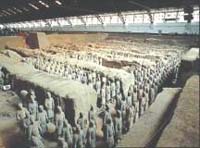
objects underground are still there. The life-size terracotta horses
and armored warriors excavated from sites near the mausoleum of
Qin Shi Huang are known as the
eighth wonder of the world, attracting swarms of Chinese
and foreign visitors every day. At the end of the Qin Dynasty, Liu
Bang, a peasant leader, overthrew the Qin regime in cooperation
with Xiang Yu, an aristocratic general. A few years later, Liu Bang
defeated Xiang Yu and established the strong Han Dynasty in 206
B.C.
In
the Han Dynasty (206 B.C.-A.D. 220), agriculture, handicrafts and
commerce were well developed. During the reign of Emperor Wudi (Liu
Che, r. 140-87 B.C.), the Han regime reached the period of its greatest
prosperity: The emperor conquered the Xiongnu nomads, and sent Zhang
Qian as envoy to the Western Regions (Central Asia), and in the
process pioneered the route known as the ??Silk Road?? from the Han
capital Chang??an (today??s Xi??an, Shaanxi Province), through Xinjiang
and onward, finally reaching the east coast of the Mediterranean
Sea. Along the Silk Road, beautiful silk products made in China
were transported to the West in a steady stream. In 33 B.C., Wang
Zhaojun, a palace maiden, was married to Huhanxie, chieftain of
the Xiongnu, leaving a moving story about marriage ties between
the Han and the Xiongnu. The multi-ethnic country became more consolidated.
The Han regime existed for a total of 426 years. It was followed
by the Three Kingdoms Period (220-265) of Wei, Shu and Wu.
The
most famous statesmen during the Three Kingdoms Period were Cao
Cao (155-220), Zhuge Liang (181-234) and Sun Quan (182-252). Cao
Cao was the founder of the State of Wei. He collected people of
talent from all over the country, stationed troops in border areas
to open up wasteland, established military farms, and finally gained
control over the Yellow River valley. Zhuge Liang was the prime
minister of the State of Shu, and a symbol of wisdom in ancient
China. For many centuries, his lofty spirit of ??bending himself
to the task and exerting himself to the utmost till his dying days??
has encouraged the Chinese people. Sun Quan was the founder of the
State of Wu. He once allied with Liu Bei (161-223) to defeat Cao
Cao at the Red Cliff, and later inflicted a crushing defeat on Liu
Bei at Yiling. In addition, Sun Quan appointed officials in charge
of agriculture, and had garrison troops or peasants open up wasteland
and grow grain, thus promoting land reclamation to the south of
the Yangtze River. Stories about them can be found in a novel called
Three Kingdoms. (r. 626-649)
The
Three Kingdoms Period was followed by the Jin (265-420), the Southern
and Northern Dynasties (420-589), and the Sui Dynasty (581-618).
In 618, Li Yuan founded the Tang Dynasty (618-907). Later, Li Shimin
(r. 626-649), son of Li Yuan, ascended the throne as Emperor Taizong,
who was one of the greatest emperors in Chinese history. Emperor
Taizong adopted a series of policies known as the Zhenguan reign
period reforms, which pushed the feudal society to the height of
prosperity. Agriculture, handicrafts and commerce flourished; technologies
for textile manufacture and dyeing, porcelain production, smelting,
metal casting and shipbuilding made great progress. During this
time, land and water transportation was also fairly well developed,
and economic and cultural relations with Japan, Korea, India, Persia,
Arabia and other countries were extensive. After the Tang Dynasty,
there came the Five Dynasties and Ten Kingdoms (907-960). In 960,
General Zhao Kuangyin of the Later Zhou Dynasty rose in mutiny,
and founded the Song Dynasty (960-1279). In 1206, Genghis Khan unified
all the tribes in Mongolia and founded the Mongol Khanate. In 1271,
his grandson, Kublai Khan, conquered the Central Plain, founded
the Yuan Dynasty (1271-1368) and made Dadu (today??s Beijing) the
capital. During the Song and Yuan dynasties, handicraft industry
and domestic and foreign trade boomed. Many merchants and travelers
came from abroad. Marco Polo came from Venice and traveled extensively
in China, later describing the country??s prosperity in his Travels.
The ??four great inventions?? of the Chinese people in ancient times??paper
making, printing, the compass and gunpowder??were further developed
in the Song and Yuan dynasties, and introduced to foreign countries
during this time, making great contributions to world civilization.
In
1368, Zhu Yuanzhang founded the Ming Dynasty (1368-1644) in Nanjing,
and reigned as Emperor Taizu. When his son, and successor, Zhu Di,
ascended the throne, he started to build the palace, temples, city
walls and moat in Beijing. In 1421, he officially made Beijing his
capital. In the Ming Dynasty, remarkable progress was made in agricultural
production and handicrafts, and toward the end of the dynasty, the
rudiments of capitalism appeared. In addition, there were friendly
contacts between China and other countries in Asia and Africa.
In
the late Ming Dynasty, the Manchus in northeast China grew in strength.
Under the leadership of Nurhachi, the Manchus invaded the Central
Plain for three generations in succession, and finally founded the
Qing Dynasty (1644-1911). The two most famous emperors of the Qing
Dynasty were Emperor Kangxi (r. 1661-1772) and Emperor Qianlong
(r. 1735-1796). The Kangxi and Qianlong reign periods were known
as the ??times of prosperity.?? During Qing rule, some novels of high
artistic value were created, of which Cao Xueqin??s Dream of Red
Mansions is the best known. It describes the decline of a prosperous
feudal aristocratic family.