
国内精品一区二区三区最新_不卡一区二区在线_另类重口100页在线播放_精品中文字幕一区在线

Guizhou
 
Inner Mongolia|Shaanxi|Tibet|Guizhou|Guangxi|Yunnan|Xinjiang|Gansu|Ningxia

Guizhou Province
Governor:
Shi Xiushi
Capital:
Guiyang
Government office
address: Provincial Government Office, North Zhonghua Road, Guiyang Telephone: 0851-6825445; 0851-6892455
Website:
http:www.gzgov.gov.cn

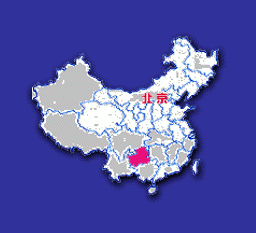
Geographical location

¡¡ Guizhou is situated on the eastern part of Yunnan-Guizhou Plateau in southwest China. Its total area is 170,000 square kilometers. On this land of towering mountains and deep valleys, there are over 300 basins which are wide in the middle and narrow in both ends and each covers over 160 hectares. The average annual temperature is between 14 and 16°C.

I. Geography and natural conditions
  Elevation extremes

  Tall in the east and low in the west, Guizhou lies over 1,000 meters above sea level.

 Natural resources

Guizhou enjoys ample precipitation. Rivers flow through steep terrain, resulting in drastic fall of the waters which gives rise to a hydro-power generating resource of 18.74 million kw, putting the province at the sixth place in the country. For each square kilometer, hydropower resources amount to 106,000 kw which is the third largest in the nation. The province is also rich in gas stored in coal reserves. The abundant water and coal reserves allow the province to draw up the strategy of developing water and coal energy at the same time.

 As one of the great reserves of minerals, Guizhou boasts more than 110 kinds of minerals, out of which the amount of reserves of 76 kinds is already known. Guizhou is among the top ten sites in the nation in the reserve of 42 kinds of minerals and the top three in 22 kinds. The province is particularly strong in the reserves of coal, phosphorus, mercury, aluminum, manganese, antimony, gold, barite, raw materials for cement and bricks, as well as dolomite, sandstone and limestone.

 With a reserve of 241.9 billion tons of coal, Guizhou has been known as ¡°home of coal in south China¡±. Its phosphorus reserve accounts to 44 percent of the national total while the mercury reserve, after long years of tapping, still makes up 38 percent of the total amount in the country. The newly discovered gold reserve of 150 tons offers the country another gold production base.

 Over 3,800 species of wild animals inhabit Guizhou. Out of this figure, over 1,000 kinds are listed as rare species under state protection. More than 3,700 kinds of medicinal herbs, or 80 percent of the total number of medicinal herbs, are found in Guizhou.

 Guizhou is a newly rising tourist destination. Unique natural scenery, rich ethnic traditions, splendid culture and history as well as pleasant climate draw tourists to the province. Now over 120 tourist sites have been opened including national scenic areas of the Huangguoshu Waterfalls, the Dragon Palace, the Golden Brocade Cave, the Red Maple Lake, the Maling River Valley and the Shizhang Cave on the Chishui River, four national nature reserves (the Fanjing Mountain Botanic Garden, the Maolan Karst Primeval Forest, the Chishui Primeval Forest and the bird reserve at Caohai), 8 national cultural relic sites and many villages with distinctive ethnic minority customs and ways of life.

Environment and current issues

In 1998, 75 incidences of environmental pollution costing 754,000 yuan were registered. In the same year, total discharge of industrial waste water was 311.13 million tons. Some 373 million tons of industrial waste water was treated with 41.49 million tons of treated industrial wastewater reaching the treatment standard. Also in 1998, total industrial waste air discharge was 33.47 million tons. In the year, waste air treatment capacity in the province was 23.3 million tons. Under construction in 1998 were 151 projects for dealing with industrial wastes, including 62 projects for treating waste water and 29 natural reserves which protect a total area of 287,139 hectares.


II. Population


 Total population: 14.57 million (1998) 

Population growth rate:
1.426 percent 

Life expectancy (average): Ethnicity:
49 ethnic groups with 48 ethnic minorities with a combined population of 8.22 million which accounts for 56.45 percent of the total population
 

Literacy:
illiterate, 28.1 percent; primary school education, 38.2 percent, junior middle school education, 25 percent; senior middle school education, 6.6 percent and college education, 2.2 percent. 


III. Economy


GDP:
84.3 billion yuan (1998)

 GDP growth rate: 8.6 percent over 1997

 Average GDP per capita: 2,323 yuan (1998)

 GDP ratio (1st, 2nd and tertiary industries): 31.1: 39.5: 29.4

 Poverty alleviation plan

At the end of 1997, 4.55 million people are listed as living under the poverty line, namely, farmers with an annual income below 600 yuan and grain below 300 kilograms. Detailed plans for alleviating poverty have been drawn and being carried out. Specifically, income of the poverty-stricken people will be raised substantially; 90 percent of the villages and towns in poverty-stricken areas will have access to electricity; program-controlled phone service will be made available to basically all towns in poverty-stricken areas. Primary education will be extended to school age children. Illiteracy among the young people will be eradicated. Most of the towns will have its own hospitals, and all villages will be served by their own clinics. Every town will establish its own cultural centers.

 Inflation rate:

 Unemployment rate:

 Revenues: total revenue in 1998 was 6.534 billion yuan

 Industrial output value and growth rate: 79.55 billion yuan with an increase rate of 13.2 percent over 1997

 Agricultural output value and growth rate: 27.45 billion yuan, showing a decrease of 2.7 percent of the 1997 figure.

 Foreign trade

Total import and export volume in 1998 was US$627.61 million, specifically, US$387.87 million for export and US$239.74 million for import. Total import and export commodity value in 1998 was US$663.81 million.

Foreign investment

Imports by enterprises with foreign investment in 1998 was US$44.68 million while export was US$16.71 million. Newly signed agreement for foreign investment was 79 in the year with US$181 million actually used. Tourism income was US$48.31 million which meant an increase of 30.8 percent over the previous year.

Pillar industries

1)      Raw material industries. Total assets in this sector were worth 36 billion yuan in 1998, including 8.2 billion yuan for metallurgy, 7 billion yuan for nonferrous metals, 600 million yuan for gold industry and 16 billion yuan for chemical industry.

2)      Machinery and electronics, including three military industrial bases of space, aeronautics and electronics. In addition, there are a number of large enterprise groups and backbone enterprises in the fields of auto-making, grinding materials and tools, engineering machinery, internal-combustion, industrial bearings, low-pressure electric equipment, precision optical instrument, industrial meter and instrument and precision machine tools for special use. Many products in these fields lead their counterparts in the nation in terms of technological level and quality. Guiyang is one of China¡¯s largest aluminum industrial bases, one of the five largest meter and instrument production bases, a major production base for grinding materials, grinding tools and cigarettes and one of the top ten electronic industrial cities in the western part of China.

3)      Light and textile industries including name-brand liquors, cigarettes and mineral waters, cotton, woolen, linen, silk, synthetic fiber, leather processing and paper making. The province holds an important position in the country in cigarettes and liquor production. Its rich resources of mineral waters give the province a broad prospect for further development in the industry. Guizhou batik is gaining increasing favor of consumers both at home and abroad and enjoying a brisk market in Japan, Africa, Europe and America.


IV. Telecommunications


Telephones

At the end of 1997, the province was served by a telephone switchboard capacity of 0.885 million sets. The total number of phone owners was 0.633 million with an additional 0.318 million users of paging service. For every 100 people in the province, there were on average 2.21 telephones.

 Radio and TV stations

 
V. Transportation


Railways

Four trunk lines radiate from Guiyang, the capital city, to neighboring provinces with a total mileage of 1,468 kilometers. Electrification transformation has been completed along the Guiyang-Kunming, Sichuan-Guizhou and Hunan-Guizhou railways, which means 1,138 kilometers out of 1,468 kilometers are under electrified operation. This change has raised transportation capacity by 100 percent.

Guizhou is a key area for railway construction in the country. So far, the section of 227 kilometers within Guizhou Province on the Nanning-Kunming Railway has been launched into service. Construction of the second electrified track of the Shuicheng-Zhuzhou Railway which will include 596 kilometers running through Guizhou and which is to be the largest east-west transportation line in the country is soon to begin. Construction for the Shuicheng-Boguo and Huangtong-Zhijin railways with investment by both the central and local governments will also begin very soon. Once completed, these transportation archeries will further elevate Guizhou¡¯s position as a major transportation pivot in southwest China, and benefit the economic development not only in Guizhou but also in neighboring Sichuan and Yunnan provinces.

Highways

Now there are over 30,000 kilometers of highways in operation in Guizhou, including five national highways and 30 provincial trunk lines which constitute a highway network with Guiyang as the center and linking up all cities and counties in the province. The first high-standard highway in the southwest¡ªGuiyang-Huangguoshu Highway has been completed while the one of the same standard between Guiyang and Zunyi was built in 1997

Waterways

In 1998, there were 33,604 kilometers of inland waterways in Guizhou with a transportation job of 3.15 million tons completed. This was 42.5 percent over the figure of the previous year.

 Airports

By 1998, air routes had been opened to link up Guiyang with 26 cities including Hong Kong, Beijing, Guangzhou, Shenzhen, Shanghai, Chengdu, Chongqing, Kunming, Guilin, Xiamen, Xian, Haihou, Changsha and Wuhan. The Longdongbao Airport, the newly completed large airport in Guiyang, was launched into service on May 28, 1997.

 
VI. Projects wanting foreign investment


Processing and storage of grain, vegetable, fruit, poultry, meat and aquatic produce

Cultivation of forest and introduction of fine breed of trees

Comprehensive utilization of bamboo resources

Rational tapping, utilization and preservation projects for water resources

Building and operation of highways, bridges and tunnels

Development of applied technology for coal processing and production

Technological transformation of enterprises of titanium smelting and processing

Development of hard-to-open mines

Technological transformation of enterprises of barium salt

Mining and product processing of phosphorus

Development and manufacture of new electronic parts

Processing and production of traditional Chinese medicinal materials

Development, construction and operation of tourist and scenic zones

 
VII. Favorable policies for foreign investment


¡°Regulations and Policies for Improving the Environment for Investment from Outside Guizhou Province¡± formulated on January 24, 1998 by the Guizhou provincial government outlines the following measures:

Exemption of enterprise income tax: For production enterprises invested with capital from Hong Kong, Macao and Taiwan as well as foreign countries (except for development projects in oil, natural gas and rare metals) and those invested with capital from other areas in China outside the province, provided they will operate for more than ten years, they shall be exempted from paying income tax for two years starting from the year they begin to generate profits; all the enterprise income tax they have paid from the third to the fifth year shall be returned by financial departments; those projects in the fields of infrastructure such as energy, transportation, water preservation, urban utilities, green industries and tourism development, provided such projects will continue their operation for over 15 years, they shall be exempted from paying enterprise income tax for two years as of the year they begin to generate profits; all the enterprise income tax they have paid shall be returned to them from the third year to the tenth year.

 Exemption of agricultural tax: For agricultural development projects using non-farmland invested with capital from outside the province, exemption of agricultural tax for 3 to 5 years is applicable from the very first year of the project. For taxable products developed on non-farmland, a period of exemption of agricultural tax for 3 years is applicable from the year profits are generated.

 Reduction of regulating tax for fixed asset investment for projects with outside-province investment in developing pillar industries and promoting progress in science and technology.

 Specially favorable treatment in collecting land use fee for investors from outside the province, in accordance with specific conditions in each area and trade.

 Outside-province investors are encouraged to take part in the reorganization and transformation of state-owned enterprises in Guizhou. Investors may choose to buy shares, take control of, jointly operate, annex, buy over, lease, trust-manage and contract these enterprises which now enjoy sound management and have a promising future. For investors from outside China, they are welcome to control shares in the enterprises unless there are regulations by the state stipulating otherwise in certain sectors.

 Foreign investors can apply for setting up investment companies once they have invested three or more enterprises in China or actual investment amounts to more than US$30 million.

 Investors from outside Guizhou are entitled to loans for floating capital and technical transformation. Projects for developing priority resources and alleviating poverty as well as providing technological transformation of existing state-owned enterprises may enjoy priority treatment in obtaining loans.

 Foreign invested enterprises have the freedom to decide the ratio of their products sold locally or exported, unless where there are specific national regulations stipulating otherwise.

 Enterprises with outside the province investment enjoy the same utility rates; Foreign investors and their families enjoy the same treatment as local residents in seeking medical treatment, going to schools, travel and buying houses.

 Intellectual properties including the patent, copyright, trademark, blueprints, designs, technical explanations, standard and computer software of outside Guizhou investors are protected according to international practice.

 Random charge imposed on enterprise with investment from outside the province beyond central government regulations are strictly forbidden.

 Well-coordinated and efficient service shall be provided so as to facilitate the business of outside investors.

 On June 8, 2000, the Guizhou provincial government issued the following measures to further encourage foreign investment;

 Foreign investors are encouraged to establish enterprises producing for export and enterprises producing for replacements of imports.

 Foreign investors are encouraged to invest in transformation of the old city districts and housing projects.

 Foreign investors may engage in exploration of mineral resources and enjoy priority rights for development.

 Foreign investors are encouraged to invest in basic industries and infrastructure including agricultural, energy, transportation and raw materials as well as environmental protection and ecological protection projects. Their investment is particularly encouraged in the area of technological transformation of state-owned large and medium-size enterprises and tourism. Foreign investors may decide to wholly-own, control shares or increase investment in enterprises, unless there are state regulations stipulating otherwise.

 Foreign invested production enterprises (except for oil, natural gas, rare minerals and expensive metals) which will operate for more than ten years are exempted from paying enterprise income tax from the first to the third year after they begin to operate with profit. Income tax will be reduced by half during the fourth and fifth year. Such enterprises located in poverty-stricken and minority-inhabited areas may enjoy 15 to 30 percent income tax reduction for the rest years in the ten-year period.

 Enterprises with foreign investment producing for export may enjoy income tax reduction by 50 percent after the initial exemption and the following reduction periods are over, if the yearly export value amounts to 70 percent or more of the enterprises¡¯ annual output value.

 Those officially recognized advanced technological enterprises may enjoy income tax reduction by 50 percent for another three years after the initial tax exemption and reduction periods are over.

 Foreign investors who reinvest their profits into enterprises which shall operate for no less than five years shall receive 40 percent return of the taxes they have already paid. If the reinvestment is made to operate enterprises for export or advanced technological enterprises, they shall receive 100 percent return of the taxes already paid.

 Production enterprises with foreign investment established in Guiyang City may enjoy 76 percent reduction of the payable income tax.

 Foreign enterprises engaged in hi-tech production in Guiyang High- and New-Tech Development Zone only pay 15 percent of income tax. Enterprises in the fields of energy, transportation, and technology-intensive and knowledge-intensive projects, each with an investment of US$30 million, established in Guiyang only pay 15 percent income tax, upon approval by the State Taxation Administration.

 Foreign invested enterprises are exempted from paying local income tax for seven years; enterprises invested by overseas Chinese, compatriots from Hong Kong, Macao and Taiwan are free from paying the tax for ten years. Development projects in energy, raw materials, transportation, telecommunications and agriculture, enterprises producing for export, enterprises of advanced technology and enterprises established in poverty-stricken and minority-inhabited areas are free from this tax for ten years while those invested by overseas Chinese and compatriots from Hong Kong, Macao and Taiwan are free from this tax for 15 years.

 Houses built or bought by foreign enterprises for their own use are exempted from real estate tax for three years as of the month built or bought.

 Taxes imposed on goods exported by foreign-invested enterprises which are registered with the industrial and commercial authorities after Jan. 1, 1994 shall be returned.

 Foreign enterprises have the right to transfer, lease, mortgage and inherit land-use right legally obtained for development, within the legally effective period.
Land obtained by foreign enterprises for development may enjoy a land-use fee reduction period of 3 to 5 years, provided the operation period is beyond 10 years.

 Favorable land-use right in development zones may include:

  25-30 percent off the land transfer fee for high- and new-technology projects recognized by the state or provincial science commissions;

  20-30 percent off the land transfer fee for enterprises in energy, transportation, telecommunication and other aspects of infrastructure;

  15-25 percent off the land transfer fee for projects in culture, education, medicine and health;

  10-20 percent off the land transfer fee for foreign enterprises producing for export; and

  Installment payment for land use fee is possible if the investor has difficulty to pay the full amount, provided the owner of the land agrees.

 Easy formalities for importing component parts, auxiliary materials and packing materials.

 Foreign investors may directly borrow capital in hard currency from banks and enterprises outside China and be responsible for payment of the principal and interest. Guarantees for borrowing that should be provided by the Chinese side proportionate to investment percentage should be incorporated into the state plan for financing outside the country.

 The Guizhou Provincial branch of Bank of China shall offer preferential treatment to foreign-invested new- and high-tech enterprises and those producing for export.

 Foreign businesses can buy shares of state-owned enterprises and take part in management in share-holding enterprises according to procedures stipulated by the state. Joint-venture enterprises can apply to the state for approval for issuing shares outside China.

 Departments responsible for issuing approval to projects with foreign investment shall issue approval or disapproval to the applicant within twenty days after receiving the project proposal, feasibility report, contract and charter, if the right of examination and approval of the projects is held at the provincial level. A decision on submitting or not submitting the documents to higher authorities should be made within fifteen days after receiving the documents, if the right of examination and approval belongs to authorities higher than at the provincial level.


国内精品一区二区三区最新_不卡一区二区在线_另类重口100页在线播放_精品中文字幕一区在线
亚洲超丰满肉感bbw| 韩国中文字幕2020精品| 国产成人在线视频免费播放| 日本欧洲一区二区| 色综合天天综合网天天狠天天| 亚洲黄一区二区三区| 在线观看91av| 激情成人综合网| 国产精品国产三级国产三级人妇| 91蜜桃在线观看| 成人黄色av电影| 久久精品夜夜夜夜久久| 99re热这里只有精品免费视频| 国产成人av一区二区三区在线观看| 国产精品国产精品国产专区不蜜| 欧美日韩视频不卡| 国产一本一道久久香蕉| 亚洲精品国产品国语在线app| 欧美一级片免费看| 成人毛片老司机大片| 午夜影院久久久| 日本一区二区免费在线观看视频| 色屁屁一区二区| 国产呦萝稀缺另类资源| 亚洲综合精品久久| 久久久精品国产99久久精品芒果 | 国产馆精品极品| 亚洲午夜精品17c| 国产亚洲女人久久久久毛片| 欧美日韩一区三区四区| 欧美日本一道本在线视频| 亚洲一区二区三区小说| 欧美日韩国产123区| 美国欧美日韩国产在线播放| 欧美xxxx老人做受| 福利一区在线观看| 亚洲欧美日韩小说| 欧美理论在线播放| 美国三级日本三级久久99| 久久久久久免费网| 91免费小视频| 日本一区中文字幕| 久久亚洲精品国产精品紫薇| 成人精品视频一区二区三区| 亚洲黄色av一区| 欧美一区二区三区四区视频| 福利视频网站一区二区三区| 亚洲色图在线看| 欧美一区二区黄色| 成人夜色视频网站在线观看| 亚洲一区二区三区视频在线 | 日韩美一区二区三区| 国产大陆a不卡| 亚洲综合小说图片| 久久亚区不卡日本| 欧美在线高清视频| 国产一区久久久| 亚洲国产欧美一区二区三区丁香婷| 欧美电影免费观看高清完整版在线观看 | 中文字幕一区日韩精品欧美| 色嗨嗨av一区二区三区| 六月丁香婷婷色狠狠久久| 中文字幕一区二区三区在线播放| 欧美人成免费网站| 成人av在线影院| 蜜臀av亚洲一区中文字幕| 亚洲三级小视频| 久久这里只有精品首页| 在线观看一区不卡| 国产成人福利片| 视频精品一区二区| 亚洲欧美国产三级| 久久久久久久网| 欧美高清激情brazzers| 95精品视频在线| 国产精品99久久久久久似苏梦涵 | 亚洲成人激情综合网| 国产精品美女久久久久高潮| 日韩欧美一级二级| 国产一区二区在线观看免费| 亚洲成人综合视频| 日本系列欧美系列| 国内精品伊人久久久久av影院| 国产精品一线二线三线| 成人免费va视频| 欧洲一区在线观看| 91精品欧美综合在线观看最新| 欧美美女一区二区三区| 精品久久久久久亚洲综合网| 国产女人aaa级久久久级| 国产精品久久久久久久第一福利 | 国产精品女同互慰在线看| 成人午夜短视频| 国产91精品欧美| 色综合久久99| 欧美网站大全在线观看| 日韩视频免费观看高清完整版在线观看| 日韩精品影音先锋| 日本一区二区电影| 亚洲五码中文字幕| 久久成人免费日本黄色| 99久久精品国产毛片| 欧美日韩精品一区二区在线播放| 日韩欧美国产一区在线观看| 欧美国产在线观看| 五月婷婷另类国产| 国产精品一区二区在线观看网站| 91免费看视频| 日韩欧美在线一区二区三区| 国产精品免费av| 日韩影视精彩在线| 99国产精品久| 欧美tickling网站挠脚心| 中文字幕中文字幕一区二区| 日韩国产成人精品| 99久久婷婷国产综合精品| 3atv在线一区二区三区| 国产精品每日更新在线播放网址| 视频在线观看一区| av在线播放成人| 精品乱码亚洲一区二区不卡| 亚洲裸体xxx| 国产剧情在线观看一区二区| 欧美三级蜜桃2在线观看| 国产日韩欧美麻豆| 另类的小说在线视频另类成人小视频在线 | 国产真实精品久久二三区| 国产精品乡下勾搭老头1| 99久久久免费精品国产一区二区| 91久久香蕉国产日韩欧美9色| 欧美三级资源在线| 欧美成人在线直播| 中文欧美字幕免费| 亚洲精品成人悠悠色影视| 日本特黄久久久高潮| 福利电影一区二区| 欧美午夜精品一区| 久久久精品国产免大香伊| 亚洲人成网站色在线观看| 日本aⅴ免费视频一区二区三区| 国产麻豆成人传媒免费观看| 日本电影亚洲天堂一区| 欧美videos大乳护士334| 国产精品美女久久久久av爽李琼 | 久久精品二区亚洲w码| eeuss鲁片一区二区三区在线看| 欧美三级中文字幕在线观看| 久久精品视频一区二区| 亚洲综合av网| 国产成人av一区二区三区在线| 欧美中文一区二区三区| 欧美精品一区视频| 亚洲国产中文字幕在线视频综合| 国产尤物一区二区| 欧美日韩精品专区| 中文字幕在线不卡视频| 蜜桃在线一区二区三区| 在线观看日产精品| 欧美国产日韩亚洲一区| 日本视频一区二区三区| 在线亚洲精品福利网址导航| 久久久一区二区三区捆绑**| 性久久久久久久久久久久| 成人爱爱电影网址| 精品国产乱码久久久久久1区2区| 亚洲人妖av一区二区| 国产成人一级电影| 精品区一区二区| 午夜精品久久久| 在线观看亚洲一区| 欧美性生活久久| 久久午夜色播影院免费高清 | 91蜜桃视频在线| 亚洲不卡在线观看| 日韩欧美中文一区| 风流少妇一区二区| 亚洲视频电影在线| 色噜噜狠狠成人网p站| 亚洲午夜久久久久久久久久久| 欧美精品日韩精品| 国产一区二区不卡老阿姨| 国产精品午夜在线| 欧美影院午夜播放| 久久er精品视频| 国产精品久久久爽爽爽麻豆色哟哟| 91同城在线观看| 日韩1区2区日韩1区2区| 久久久国产精品不卡| 91视频在线观看免费| 石原莉奈在线亚洲二区| 久久久久久久综合色一本| 91老师国产黑色丝袜在线| 青青草视频一区| 欧美国产日韩a欧美在线观看| 欧洲国产伦久久久久久久| 激情文学综合丁香| 亚洲激情六月丁香| wwww国产精品欧美| 日本高清不卡aⅴ免费网站| 经典三级视频一区|