Buildings in Imperial Mausoleums
In addition to the pyramids or walls with soul towers as primary tomb signs, many carved stone statues were erected as guards of honor in front of the mausoleums with their spaces ranging in size from several dozen Ii (1 Ii =0.5 km) up to over one hundred Ii in circumference, comparing in size to the imperial palace gardens of the tomb occupants. For instance, the mausoleum of Emperor Qin Shi Huang is over 12 Ii in circumference, and the Zhaoling mausoleum of Emperor Tai Zong of Tang, including the area of the attendant tombs, covers 300 thousand mu (1 mu = 0.067 hectare) over an area 120 li circumference. The Ming Tombs in Changping, Beijing and the East and West Imperial Tombs of the Qing Dynasty in Hebei Province all are more than a hundred and up to several hundred li in circumference.
Buildings on the grounds of imperial tombs can be divided into three categories:
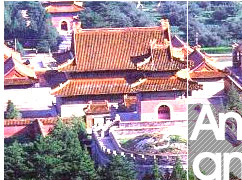
1) Buildings of the sacrificial type as the main part of surface structures on the tomb ground, the most important one being the sacrificial hall. The attendant structures are side halls and covered corridors; in front are burners and gates, and at the rear are stone altars for placing sacrificial vessels.
This type of surface structure used to a sacrificial purpose was developed gradually from initial, simple forms. By the time of the Tang Dynasty, the sacrificial complex at the Qianling Mausoleum for a joint burial of Emperor Gao Zong of the Tang Dynasty and Queen Wu Zetian consisted of 378 rooms. Well preserved are the imperial tombs of the Ming and Qing dynasties, which illustrate that the tomb structures resemble the imperial palaces in which the occupants had lived.
A look at the buildings of the East Tombs of the Qing Dynasty offers a good example. Built in front of the Soul Tower are:
A stone throne supporting a sacrificial altar of stone carving with five sacrificial pieces on: A stone incense burner flanked by two candle stands and a pair of flower vases carved from stone. These seem to make up a scene of endless offering.
Two-pillar gate: A lofty memorial archway supported by two pillars.
Three gates: Glass gates leading to the sacrificial hall.
Three-arch bridge: Erected in front of the three gates and leading to the sacrificial hall.
Sacrificial hall: Large hall for offering sacrifices which contains rooms and Buddhist towers.
East and west side halls: The east side hall is where ivory tablets used for praying were supplied and the west side hall is where lamas chanted scriptures.
Silk-burning stove: A stove built of glass blocks in the shape of a small pavilion.
Long'en Gate: A large gate connected with the wall surrounding the sacrificial hall area.
Graveyard guard's rooms: Three rooms to the east and another three west, all roofed with gray tiles.
Boiling rooms: Five rooms in the east for boiling tea and another five in the west for steaming buns.
Holy kitchen store: The holy kitchen store, containing the slaughter pavilion and the well pavilion, is the place where sacrificial foods were prepared and stored.
Tablet pavilion in the sacrificial hall area: An entrance into the complex of buildings for holding the ceremonies of sacrifice offering. It is also called the pavilion housing tablets on the spirit path or tower for housing tablets. Inside stand stone tablets with inscriptions of posthumous titles of the deceased rulers.
2) Spirit path. The spirit path, also called the Imperial Road, is the passage leading to the sacrificial hall and a tomb. It is designed mainly to display the magnificence of the tomb. Each tomb has one spirit path; however there is only one main spirit path in each imperial mausoleum or complex of tombs, generally leading to the mausoleum of the earliest emperor. Typical are the tomb of Emperor Yong Le (Zhu Li on the throne from 1403 to 1424), the main tomb in the Ming Tombs, the tomb of Shun Zhi (on the throne from 1644 to 1661), the main tomb in the East Tombs, and the Tomb of Yong Zheng (on the throne from 1723 to 1735), the main tomb in the West Tombs. Each of these tombs is served by a main spirit path. All the other imperial tombs in these mausoleums only have secondary spirit paths.
The spirit paths have also experienced development from modest to lavish. In the beginning, when the tomb mound came into existence, a temple for offering sacrifices was built in front of the tomb. Linking the tomb and the temple was a tidy walk known as tomb path. Originally the path was short, sometimes with a few carved stones mounted on its sides and a watchtower on either side of its entrance. A small number of carved stones at early tombs have been preserved, but no stone carvings have been discovered at any imperial tombs of the Qin and Han dynasties, except for fourteen carved stones at the tomb of general Huo Qubing (140 BC-117 BC) of the Western Han Dynasty.
However, these carved stones are quite different from stone statues erected on later imperial spirit paths. Mythical stone animals, such as bixie or tianlu bixie, came to be placed at the watchtowers of tombs in the Eastern Hart Dynasty (25-220) in Henan and Sichuan provinces. These were designed to denote that the exalted earthly position of the deceased was granted from Heaven, giving the stone animals power to exorcise evil spirits. In the Six Dynasties, the imperial tombs, located near Nanjing, had bixie, lions, memorial tablets and tomb-stones, forming a basic standard or requirement for an Imperial tomb. By the time of the Tang Dynasty, the spirit path in front of mausoleums developed into a long roadway with large carved stones forming guards of honor along its length.
In the Ming and Qing dynasties, the spirit pathways of imperial tombs developed to their extremes. In evidence of these are the length of spirit paths of the Ming Tombs totaling over 7 kilometers, and that of the East Imperial Tombs of the Qing Dynasty, 5 kilometers. The ground structures and carved stones lining the pathways of both the East Imperial Tombs of the Qing Dynasty and the Ming Tombs are similar. To give an idea of the grandeur of the displays, here is a listing of structure along the spirit path of the East Imperial Tombs of the Qing Dynasty:
Stone memorial archway: A stone carving resembling a wood-structure archway stands at the entrance of the imperial tomb area.
Great Scarlet Gate: The front gate of the imperial tomb area.
Locker hall: Situated at the east side, behind the Scarlet Gate, the hall provides room for changing clothes prior to ceremonies for offering sacrifices to the deceased.
Tower housing the Tablet of Devine Merit and Sage Virtue: Inscriptions on a tablet in the tower record memorable deeds of the deceased monarch. At the four comers of the tower stand four ornamental columns.
Screen Hill: It is a replica of the tomb hill located to separate the inside from the outside of the mausoleum.
Shiwang Columns: Marking entrance to the rows of statues of guards of honor.
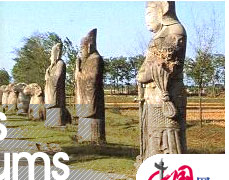
Carved figures and animals: These are carved stone guards of honor in the shape of lifelike officials, officers and rare animals known as "stone figures and horses," "stone figures and animals" or "eighteen pairs" lining the spirit path of tombs.
The "eighteen pairs," in order from Shiwang columns, are a pair of sitting, then a pair of standing, lions; a pair of sitting, then a pair of standing ancient goats; a pair of sitting, then of standing, camels; a pair of lying, then of standing, elephants; a pair of sitting, and of standing, unicorns; a pair of lying, then of standing, horses; two pairs of standing officers; two pairs of standing officials, and two pairs of standing officials distinguished for meritorious service to the imperial court.
Dragon and Phoenix Gate: Also called the Lingxing (Lattice) Gate, it marks the center of the mausoleum yard, a halfway point to the tombs.
Seven-arch bridge: Since the long spirit path was crossed by streams and brooks, bridges were necessary. This bridge, named for its arches, was a component of the path and was also called the Spirit Path Bridge.
Pavilion (or tower) housing tablets at the devine path: It is part of the sacrificial hall area.
3) The guard section. This was also known as the mausoleum observation section in the Ming and Qing dynasties, designed to undertake the specific task of looking after imperial mausoleum behind high walls. Along with sacrificial buildings, streets, lanes, and residences there were also various administrative organs instituted to prevent looting and damage because the occupants were supreme and enormous numbers of precious objects were buried in the tombs.
Institutions invested with administrative power were first set up in the Qin Dynasty at the mausoleum of Emperor Qin Shi Huang. The Maoling Mausoleum of Emperor Wu Di (on the throne from 140 BC to 87 BC) was the first to have its residential ground for rich merchants, wealthy landlords and big officials and the Maoxiang Village, where the tomb was situated, was elevated to county level.
The officials, officers and rich merchants who moved there numbered more than 270 thousand; as a result Maoxiang became the richest place in the capital of Chang'an. Beside local officials duty bowed to protect the mausoleums, other officials were assigned specifically to various jobs. They were directors and chiefs, their subordinates, and petty officials keeping the mausoleums under protection. According to surviving documents, the number of keepers responsible for watering trees and cleaning the tomb ground in a single mausoleum came to as many as more than five thousand.
The large numbers of people needed to protect the mausoleums naturally required prodigious amount of provision and service work; thus the mausoleum zones, originally desolate, developed rapidly. Typical were the areas around the Changling Mausoleum of Han Dynasty Emperor Gao Zu (Liu Bang on the throne from 206 BC to 195 BC), the Anling Mausoleum of Emperor Hui Di (Liu Yin on the throne from 194 BC to 188 BC), the Yangling Mausoleum of Emperor Jing Yang Di (Liu Qi on the throne from 156 BC to 141 BC), the Maoling Mausoleum of Emperor Wu Di and the Pingling Mausoleum of Emperor Zhao Di (Liu Fuling on the throne from 86 BC to 74 BC), which were elevated to county status after the mausoleums were built and became prosperous zones. In addition to the institution of a tomb observation section, a "new city" was set up at the East Imperial Tombs of the Qing Dynasty in Zunhua County, Hebei Province, to guard the tombs.