Returning Home—Przewalski's Horse Reintroduction
Project
In 1966 people last saw the Przewalski's horses in the wild.
Since then, this rare species, commonly known as the wild horse,
can be found only in zoos. The Przewalski's Horse Reintroduction
Project of China was initiated in 1985 when the country introduced
11 wild horses from overseas. After more than two decades of
dedicated efforts, the Xinjiang Wild Horse Breeding Center managed
to breed a large number of the horses, of which 55 were let loose
into the Kalamely Mountain area, a place where their ancestors once
roamed freely.
Reintroduction
When the journalist stepped over the fence, all the horses
stopped grazing and raised their heads cautiously. While the rest
stood still, the dominant stallion circled the herd to mark his
territory. When the journalist tried to get nearer, the whole herd,
led by the dominant stallion, whirled and broke into a fast gallop
along the fence, causing flakes of snow to fly all about.
The Xinjiang Wild Horse Breeding Center is some 60 kilometers
from Gymsar Town. When the journalist arrived, all 117 Przewalski's
horses bred here had just recovered from a serious disease. In the
past, the center's staff attended the animals carefully. None of
them relaxed until they had made sure all the horses were
completely restored to health.
The last Przewalski's horse was last sighted in the wild in
1966. Since then international organizations have been working hard
to save the rare species. "Currently there are no more than 2,000
such horses around the world. In this sense, this species is even
more precious than the giant panda," explained Cao Jie, director of
the breeding center.
Horses reintroduced into the wild are now reproducing slowly due
to their long captivity. Although the original intention was to
protect the animals from extinction, artificial breeding has caused
a drastic decline in the horses' physical strength and their power
to resist diseases. Given these facts, specialists around the globe
have agreed that the best way to sustain the species was to
reintroduce them into the wild.
In the 1980s, the reintroduction program kicked off in Mongolia
and China's Xinjiang Uygur Autonomous Region. The two countries,
however, differ widely in their methods of freeing the animals. In
Mongolia, horses are released into the wild immediately after they
are imported from foreign zoos. When a horse is found dead,
authorities will import another one in order to replenish the herd.
Requiring high capital, this method can't maintain stable
population growth and such a small group of horses have great
difficulty surviving in the wild. In comparison, Chinese experts
free the horses only after they have multiplied into a relatively
large herd inside the breeding center. "Our original plan was to
free the horses when the herd reached 80 head," explained a staff
member.
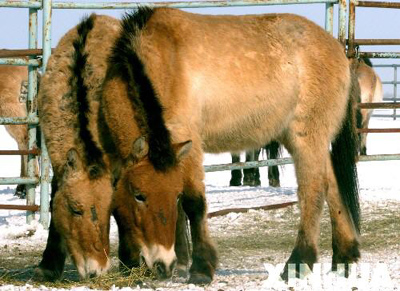
Some 160 kilometers away from Urumqi, the center is a
three-story blue building 15 kilometers off an expressway. There
are a total of 12 stables. Each is home to a family group of
horses. Next to the stables is a fenced pasture covering 200
hectares. All horses remain in the pasture to acclimate to the wild
before they are finally released.
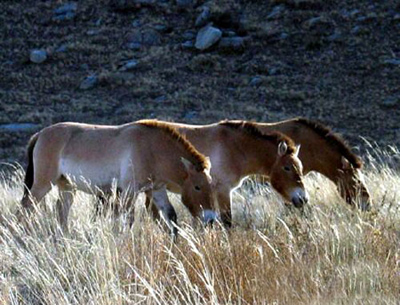
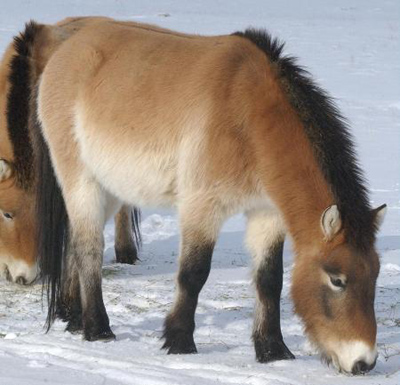
At the first glance, wild horses are easily mistaken for
donkeys, but a wild horse has a smaller head and shorter ears. Its
tail is loose but not as long as that of the domesticated horse.
Wild horses are usually strongly built and an adult stands some 1.5
meters high. They command an obvious advantage when fighting with
domesticated horses, because horses tend to bite their rival's
forelegs, and the smaller body of the wild horse means quicker
maneuvers. The coat of wild horses is predominantly light brown but
it darkens in the summer. In the wild, it is difficult to approach
a wild horse because the highly vigilant animal will run away when
it is still hundreds of meters away from human beings. Unlike
domesticated horses, the manes of wild horses are extremely short
and stand straight up as if they have just been given a crew
cut.
When two wild horses help each other with grooming, they stand
close together head to tail and stretch their heads over each
other's bodies while nipping softly. When one horse changes
position, the other will change correspondingly. When a group of
wild horses stand at rest, they will group together in a circle
with their heads clustering in the middle. The dominant stallion
usually positions himself in the center of the circle, keeping
alert for unusual sounds. This is the best way for the wild horses
to protect themselves. When under attack, they will kick the enemy
forcefully with their hooves.
The breeding center covers a total area of 600 hectares, most of
which, unfortunately, lies upon alkaline land that does not support
vegetation and is unsuitable for farming. "We hope one day we can
plant grass on this land and let the horses to eat by themselves.
Currently, we feed the horses four times a day. We have tried to
replenish patches of land with better soil to grow natural grasses
but it was not cost effective."
Fortunately, the imported wild horses quickly adapted to their
new environment. In 1988, six foals were born and survived. This
indicated that the animals had managed to overcome breeding
difficulties in this semiarid region. "In 2001, when we were about
to release some horses into the wild, there were over 100 horses at
the center. Now both their reproduction rate and survival rate are
the highest in the world. Moreover, the parasites that used to
trouble them in foreign countries have never been found here.
Perhaps because they have returned to their ancestral home," said
Cao Jie proudly.
Hard return
To release the horses into the wild is the final aim of the
reintroduction program. However, the return was realized only after
Honghua, the first horse born at the center, died in an
accident.
"The wild horses are physically mature at the age of three, but
they are sexually mature at two. If a mare gets pregnant when not
fully grown up, she is prone to abortion," explained Yan Hui, a
technician at the center. When Honghua entered breeding age, she
was the fattest mare at the center. "When a mare's udders hang
heavy and turgid, with milk dripping out, an experienced breeder
knows she will give birth in hours or at most in a day." Honghua
had successfully borne five foals before, but on May 13, 2000, when
it was her time to give birth to her sixth one, she experienced
difficulties with the delivery. When a specialist finally arrived
at the center from hundreds of miles away, part of the mare's
intestines had slipped out of her body. A staff worker tried to
anaesthetize her with a special rifle, but the mare got startled
and began to gallop. The unfortunate animal only ran a few meters
before treading upon her own intestines and dying. After Honghua's
tragedy, the specialist conducted an investigation and concluded
that the mare's difficult delivery was due to obesity. She got too
fat due to her long period of captivity and insufficient physical
exercise. Her tragedy pushed forward the agenda of the return to
the wild plan for the horses. And, as a matter of fact, the horse
population had surpassed 80 a long time ago, but their release had
been delayed over and over due to a lack of funds.
The first group of the Przewalski's horses was set free in the
Kalamely Mountain area, where the ancient wild horses had
originally lived and multiplied. Some 40 kilometers from Charcurt
Town and 310 kilometers down the National Highway No. 216, staff
members of the breeding center constructed a small white house to
monitor the conditions of the horses. Next to the house, they
created a fenced pasture covering four square kilometers. On August
8, 2001, the first group of 27 horses arrived and lived inside the
pasture for 20 days before they finally went into the wild.
"Initially, we wanted to choose horses with distant family
relations. But taking into account that these animals are
gregarious with strong hostility towards newcomers, we selected out
a family group to ensure the herd's stability. In the beginning, we
chose 21 horses, including one stallion and seven mares. But six
more foals were born inside the fenced pasture. This notched the
total number up to 27," recalled Wang Zhenshan, a five-year veteran
worker at the Charcurt Monitoring Station.
Plants were abundant inside the fenced pasture, but the wild
horses were unaccustomed to water with high alkaline content. In
the beginning, they drank frequently every day but sipped water in
extremely small amounts each time. To help the horses get used to
the water, station staff went to the Urum River to fetch purer
water. On the first day, they added one share of the river water
into one share of local water, and in the following days, they
diminished the portion of river water gradually until the horses
finally got used to the local conditions.
At 9:00 AM, August 28, 2001, 27 wild horses, led by the dominant
stallion called Dashuai, galloped off northwestwards toward the
large mountain. Half an hour later, the staff members set out to
find the horses, but they discovered nothing and themselves got
lost in the darkness. Fortunately, the horses came back by
themselves the next morning. "When they galloped back along
National Highway No. 216, we traced their journey by following
their hoof prints. These horses had run some 50 kilometers during
the night," exclaimed Wang Zhenshan.
Since then, Wang had to get up at 7:00 every day to trace the
horses and monitor their conditions. When he came back, it was
usually late at night. "After a few days, I had a few insights.
There are three things to notice when tracking horses: the water
source, horse dung and hoof prints. The hoof print of the wild
horse is heart shaped. When I find these tracks, I will first
figure out whether there is a water source in the neighborhood. If
there is one, I will go there to wait for the horses because sooner
or later, they will come to drink water. Also, I will observe the
dung. If it's still fresh, the horses must have been there not long
ago," Wang Zhenshan explained.
Wild horses tend to migrate between water sources around
Kalamely Mountain. "There used to be many seasonal water sources
around Kalamely Mountain, but in recent years, this region has
suffered a long drought and lots of the water sources have
vanished. Today, there are, at most, 40 to 50 fixed water sources.
Of them, only a little over 10 are suitable for drinking. We will
be fully confident of the horses' survival in the wild only when
they find permanent water sources, which means that they would have
regular places to live through the winter and places to graze
during the summer," said the station's director Wang Chen.
In addition to water sources, domesticated horses also pose a
major threat to the wild horses. In the Altay Prefecture, herdsmen
of the Kazak Ethnic Group migrate to the Wucaiwan Winter Pasture
every year. Their livestock will eat up all the grass when passing
through Charcurt Town. And up to now, the greatest fear of the
station staff is that the Kazak domesticated horses may breed with
the Przewalski's horses, create hybrids, and badly affect their
gene pool.
Shortage of financial aid
The breeding center started to release the horses into a
semi-wild environment beginning in the winter of 2001. Frightened
by nomadic herdsmen, the herd of horses ran into the wilds of
Kalamely Mountain. The thick snow threatened the horses' lives and
hindered the center's search operation. After twenty days of great
effort, the search team finally located the lost horses. They found
the dominant stallion exhausted and the mare expected to play the
role of "queen" missing. The dominant stallion died shortly after
he was returned to the fenced pasture.
The center then imported another two stallions to fill the gap
of the former leaders. The two newcomers each vied for several
female partners and split apart the original herd. Generally, the
optimized number for a herd consists of one male horse and five to
seven female ones.
Then, in order to keep the blood pure, the new stallions killed
all the foals born the next spring by biting them to death.
Finally, in the spring of 2003, upon the birth of the new leaders'
offspring, the horses crossed the threshold toward survival and
reproduction in the wild.
According to the center staff, wild mares usually give birth
from May to August and enter heat one week after giving birth. The
pregnancy period lasts about 340 days. Since winters are critical
times for pregnant horses, the center keeps the horses in captivity
to prevent them from disturbing herdsmen. To mimic the natural
environment, the center scatters bundles of hay inside the fence
and forces the horses to discover food covered by the heavy snow.
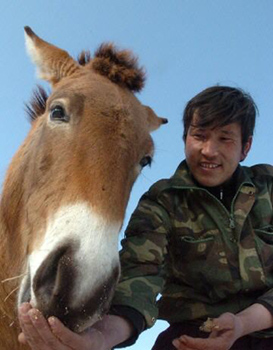
Such measures also keep wild horses from human contact and
cultivate their alertness.
After leaving the fenced pasture, wild horses will sometimes
stop by their "old homes". Sometimes, they even return to the
permanent water source during dry season.
"One of the new groups released this year left the fenced
pasture last May and reappeared in September of this year," said
Wang Chen.
Six years from the first release, the second and the third
generation of the horses have indeed managed to survive in the
Kalamely Mountain areas. They have learned to forage for food and
water and fight against enemies.
"We urged a wolfhound to attack the horse drove. The dominant
stallion organized a fan-shaped battle formation immediately with
the strong horses in the front and the weak ones behind," said Wang
Zhenshan. "The stallion, standing in front, fought against the
hound with its hooves. When we managed to pull the hound out of the
battle, it was at its last gasp. These wild horses are capable of
protecting themselves from wolf attacks."
However, the ultimate goal lays in the offspring of the first
batch of wild horses released into the natural environment. "We
hope their offspring can adapt to the wild environment," said Wang
Chen, adding that since the wild horses can reproduce in the
wildness, they are considered able to survive.
In contrast to their success with wild horse cultivation, the
center failed to make financial ends meet. The expense in 2006 was
1.7 million yuan (about US$2.3 million), 6 million (about US$0.81
million) more than the fund earmarked by the central government.
The tight budget has driven away dozens of employees. A total of 17
regular employees and 10 part-timers work at the center. Some 100
people have worked there, but few of them have stayed for more than
15 years. "The average salary of a regular employee is 1,300 to
1,400 yuan (about US$177 to 190) and a part-timer only 700 yuan
(about US$95)," explained Director Cao. "Four workers now have to
cover the work used to be done by the six to feed the horses."
The working and living conditions are so harsh that many people
have balked and left. They had to dig wells by themselves and
relied on diesel electric generators until 2002 when they ran an
electric cable from a nearby herdsmen's settlement with the aid of
a governmental subsidy.
The nearest township is approximate 20 kilometers away from the
center. The workers have to cycle to the post office there to make
a phone call and keep touch with their families. The center has two
rows of single-story houses for use as dormitories; the horse
stables are directly behind them. A three-story building was
erected in 2003 to improve living conditions, but the money for
construction left the center officials scratching their heads.
The government allocated funds based on 76 horses. But now more
than 170 horses, raised in captivity and in the wild, exist. The
nationwide price hike has also hit this remote area, with the price
of hay nearly doubling up to one yuan (14 US cents) per kilogram.
In the past, the center would prepare special feed for stallions
before the breeding season. But some nutritious ingredients, such
as barley, bran and eggs have been crossed off the menu due to
soaring prices.
Last year, America gave three GPS neckbands to the center as a
gift, which saved the center manpower and time to search for the
wild horses. However, the new technology is far from popular due to
the shortage of money. "We only use the electric neckbands from 9
AM to 6 PM so as to prolong their service life because one such
neckband costs US$5,000," said Wang Chen.
The movement of Kazak herdsmen has had the greatest influence on
the wild horses' lives. Although the government has helped the
nomadic ethnic minority to settle down, it is difficult to change a
people's life style in a short period of time. "It takes a lot of
money and time to do surveys on herdsmen's living habits and
conditions as well as map out a feasible relocation plan," said Cao
Jie, the director.
(China.org.cn by Chen Xia, Huang Shan, December 28, 2007)