



The Constitution of the PRC stipulates that the country's central state organs mainly comprise six components: the National People's Congress (NPC), the Presidency of the PRC, the State Council, the Central Military Commission, the Supreme People's Court and the Supreme People's Procuratorate.
The five organs--the Presidency of the PRC, the State Council, the Central Military Commission, the Supreme People's Court and the Supreme People's Procuratorate--are formed by the NPC, and are responsible to the NPC and its Standing Committee.
National People's Congress and Its Standing Committee
The NPC is the highest organ of state power. The NPC and local people's congresses at all levels are all formed through democratic elections.
The NPC consists of deputies elected by 31 provinces, autonomous regions and municipalities directly under the Central Government, special administrative regions and the Chinese People's Liberation Army. Every ethnic minority has an appropriate number of representatives in the NPC.
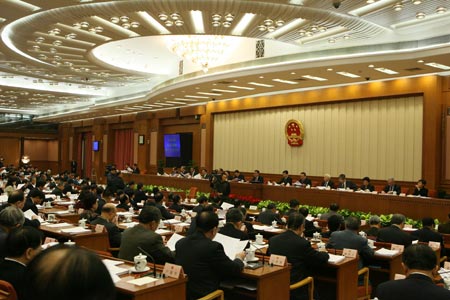 |
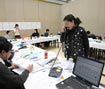
The National People's Congress (NPC) is the highest organ of state power. Pictured is a meeting of the 10th NPC Standing Committee.
The NPC exercises the legislative power of the state, including amending and supervising the enforcement of the Constitution and enacting and amending basic laws and laws governing other matters. It also enjoys the power to elect, decide on and remove leaders and members of the highest state organs, oversee the government, and examine and decide on major state issues in line with the Constitution and other state laws. The administrative, judicial, procuratorial, military and other organs of the state are created by the organ of state power, and are therefore supervised by and responsible to it.
The NPC is elected for a term of five years. It meets in session annually, convened by its Standing Committee. The current NPC is the 10th since its inception. According to an announcement of its Standing Committee, the 10th NPC had 2,988 deputies as of March 5, 2007.
The NPC Standing Committee is the permanent body of the NPC. It exercises the highest state power when the NPC is not in session. The NPC Standing Committee is composed of the chairperson, vice chairpersons, secretary general and members.
The current chairman of the NPC Standing Committee is Wu Bangguo. Wang Zhaoguo, Li Tieying, Ismail Amat (Uygur), He Luli (female), Ding Shisun, Cheng Siwei, Xu Jialu, Jiang Zhenghua, Gu Xiulian (female), Raidi (Tibetan), Sheng Huaren, Lu Yongxiang, Uyunqimg (female, Mongol), Han Qide and Fu Tieshan (dead) are incumbent vice chairpersons. Sheng Huaren serves as secretary general of the NPC Standing Committee, concurrently.
Successive NPCs
|
Term |
Opening |
Deputies |
Standing Committee Chairman |
|
First |
Sep. 1954 |
1,226 |
Liu Shaoqi |
|
Second |
Apr. 1959 |
1,226 |
Zhu De |
|
Third |
Dec. 1964 |
3,040 |
Zhu De |
|
Fourth |
Jan. 1975 |
2,885 |
Zhu De |
|
Fifth |
Mar. 1978 |
3,497 |
Ye Jianying |
|
Sixth |
Jun. 1983 |
2,978 |
Peng Zhen |
|
Seventh |
Mar. 1988 |
2,978 |
Wan Li |
|
Eighth |
Mar. 1993 |
2,977 |
Qiao Shi |
|
Ninth |
Mar. 1998 |
2,980 |
Li Peng |
|
10th |
Mar. 2003 |
2,985 |
Wu Bangguo |
President of the People's Republic of China
The president and vice president of the PRC are elected by the NPC. The NPC has the power to remove from office the president and vice president of the PRC. The president and vice president of the PRC are elected to the same length of term as the NPC and shall serve no more than two consecutive terms.
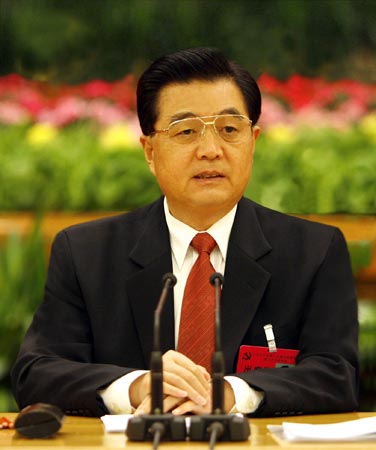 |
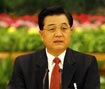
Hu Jintao is incumbent president of the People's Republic of China
The president of the PRC, in pursuance of decisions of the NPC and its Standing Committee, promulgates statutes; appoints or removes the premier, vice premiers, state councilors, ministers in charge of ministries or commissions, the auditor general and the secretary general of the State Council; confers state medals and titles of honor; issues orders of special pardons; proclaims martial law; proclaims a state of war; and issues mobilization orders. The president of the PRC also receives credentials offered by foreign diplomatic representatives on behalf of the PRC and, in pursuance of decisions of the NPC Standing Committee, appoints or recalls plenipotentiary representatives abroad and ratifies or abrogates treaties and important agreements concluded with foreign states.
Previous presidents of the PRC were Mao Zedong, Liu Shaoqi, Soong Ching Ling (honorary), Li Xiannian, Yang Shangkun and Jiang Zemin.
Hu Jintao is incumbent president of the PRC and Zeng Qinghong is incumbent vice president.
State Council
The State Council, or the Central People's Government, is the executive body of the highest organ of state power and the highest organ of state administration. It takes responsibility and reports its work to the NPC and its Standing Committee.
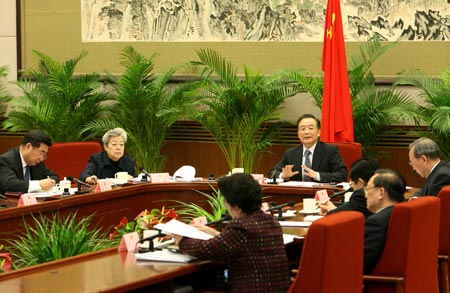 |
The State Council is the highest organ of state administration. Pictured is a meeting presided over by incumbent Premier of the State Council Wen Jiabao.
The State Council is composed of the premier, vice premiers, state councilors, ministers in charge of ministries or commissions, the auditor general and the secretary general. The premier of the State Council is nominated by the president, decided by the NPC, and appointed and removed by the president. Other members of the State Council are nominated by the premier, decided by the NPC or its Standing Committee, and appointed and removed by the president. The term of office of the State Council is of the same length as the NPC, and its members shall serve no more than two consecutive terms.
Previous premiers of the State Council were Zhou Enlai, Hua Guofeng, Zhao Ziyang, Li Peng and Zhu Rongji.
Wen Jiabao is incumbent premier of the State Council. Incumbent vice premiers are Huang Ju, Wu Yi (female), Zeng Peiyan and Hui Liangyu. Zhou Yongkang, Cao Gangchuan, Tang Jiaxuan, Hua Jianmin and Chen Zhili (female) are incumbent state councilors.
The General Office of the State Council, under the leadership of the secretary general, is in charge of routine affairs of the State Council. Current secretary general of the State Council is Hua Jianmin (concurrently).
Ministries and commissions under the State Council (28): Ministry of Foreign Affairs, Ministry of National Defense, National Development and Reform Commission, Ministry of Education, Ministry of Science and Technology, Commission of Science, Technology and Industry for National Defense, State Ethnic Affairs Commission, Ministry of Public Security, Ministry of State Security, Ministry of Supervision, Ministry of Civil Affairs, Ministry of Justice, Ministry of Finance, Ministry of Personnel, Ministry of Labor and Social Security, Ministry of Land and Resources, Ministry of Construction, Ministry of Railways, Ministry of Communications, Ministry of Information Industry, Ministry of Water Resources, Ministry of Agriculture, Ministry of Commerce, Ministry of Culture, Ministry of Health, State Commission for Population and Family Planning, People's Bank of China and National Audit Office.
Special agency directly under the State Council (1): State-Owned Assets Supervision and Administration Commission
Agencies directly under the State Council (18): General Administration of Customs, State Administration of Taxation, State Administration for Industry and Commerce, General Administration of Quality Supervision, Inspection and Quarantine, State Environmental Protection Administration, General Administration of Civil Aviation, State Administration of Radio, Film and Television, General Administration of Press and Publication (National Copyright Administration), General Administration of Sport, National Bureau of Statistics, State Forestry Administration, State Food and Drug Administration, State Administration of Work Safety, State Intellectual Property Office, National Tourism Administration, State Administration for Religious Affairs, Counsellors' Office and Government Offices Administration
Offices under the State Council (4): Overseas Chinese Affairs Office, Hong Kong and Macao Affairs Office, Legislative Affairs Office and Research Office
Institutions under the State Council (14): Xinhua News Agency, Chinese Academy of Sciences, Chinese Academy of Social Sciences, Chinese Academy of Engineering, Development Research Center, National School of Administration, China Earthquake Administration, China Meteorological Administration, China Banking Regulatory Commission, China Securities Regulatory Commission, China Insurance Regulatory Commission, State Electricity Regulatory Commission, National Council for Social Security Fund and National Natural Science Foundation
Administrations and bureaus under ministries and commissions (10): State Bureau for Letters and Calls, State Administration of Grain, State Tobacco Monopoly Administration, State Administration of Foreign Experts Affairs, State Oceanic Administration, State Bureau of Surveying and Mapping, State Post Bureau, State Administration of Cultural Heritage, State Administration of Traditional Chinese Medicine and State Administration of Foreign Exchange
Central Military Commission
The Central Military Commission (CMC) is the highest military leading organ of the PRC. It directs the armed forces of the country. The CMC is composed of the chairman, vice chairmen and members. The chairman of the CMC is elected to the same length of term as the NPC, but there is no restriction on his/her tenure of office.
 |
Members of the Central Military Commission (CMC) and newly promoted generals pose for a group picture at a ceremony in Beijing on June 24, 2006. CMC is the highest military leading organ of China.
The armed forces of the PRC are composed of the People's Liberation Army (PLA), the Chinese People's Armed Police Force and the militia.
Hu Jintao is incumbent CMC chairman. Nominated by Chairman Hu, the CMC currently consists of vice chairmen of Guo Boxiong, Cao Gangchuan and Xu Caihou, as well as members of Liang Guanglie, Li Jinai, Liao Xilong, Chen Bingde, Qiao Qingchen, Zhang Dingfa (dead) and Jing Zhiyuan.
Supreme People's Court
People's courts form the judicial organs in China. The state sets up the Supreme People's Court, local people's courts at all levels, and military and other special courts.
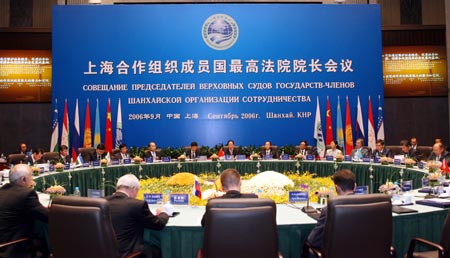 |
The Supreme People's Court is strengthening judicial exchanges and cooperation with foreign counterparts. Pictured is a meeting of presidents of supreme courts of Shanghai
The Supreme People's Court is the highest judicial organ of the country. It is responsible to the NPC and its Standing Committee, and reports its work to them. The Supreme People's Court independently exercises the highest judicial power according to law and is not subject to interference by any administrative organ, social organization or individual.
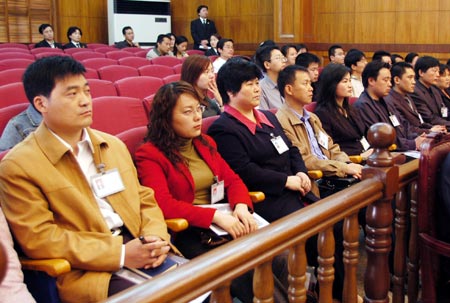 |
The people's juror system plays an important role in promoting judicial fairness. Pictured are people's jurors in a court hearing in Nanjing, Jiangsu Province.
According to the Constitution and statutes, the Supreme People's Court has three responsibilities:
--Handling cases that have the greatest influence, cases of appeals against judgments and rulings of higher courts and cases it deems it should deal with;
--Supervising the administration of justice by local people's courts and military and other special courts at all levels, overruling wrong judgments they have made, and deciding to review the cases itself or to direct the lower-level courts to conduct a retrial; and
--Giving judicial interpretation of questions concerning special applications of laws in judicial proceedings, which must be carried out throughout the country.
Work of the Supreme People's Court in 2006
In 2006, the Supreme People's Court concluded 3,668 cases, up 14.77 percent over the previous year. Of the total, there were 405 criminal cases. It also ruled on 673 civil cases, involving 15.1 billion yuan; closed 318 administrative cases and cases of state compensation; coordinated and supervised the cross-region enforcement of 213 civil case rulings; and accepted 2,059 appeals and demands for retrial. In accordance with the needs of judicial works, the court also published 12 legal interpretations and 36 judicial directives.
In the year, the court performed its functions in the administration of justice in strict accordance with the law and offered strong legal guarantees.
The court focused on the crackdown on criminal activities of various kinds, helping to safeguard national security and social stability. Under its leadership, local courts at all levels intensified the fight against crimes endangering national security, terrorist activities, organized crimes and other criminal activities severely threatening public security. Courts across the country in 2006 tried and concluded 245,254 criminal cases involving felonies such as explosion, murder, robbery, rape and kidnapping, and sentenced 340,715 criminals convicted in such cases.
The campaigns against corruption and commercial bribery made progress. Judges handled 23,733 cases of embezzlement, bribery and dereliction of duty in the year. Among them, those involving corporate employees and public servants amounted to 359 and 8,310, respectively. The courts also sentenced 825 convicted government officials above the county level, including 52 prefectural- and departmental-level officials and nine provincial- and ministerial-level officials. In the crackdown on crimes endangering the socialist economic order, 16,679 cases of producing and marketing shoddy and counterfeit goods, smuggling and breaching financial regulations were settled, with 22,944 people being sentenced to prison. Courts across the country also tried and concluded 31,582 cases involving the manufacture, trafficking and sale of narcotics, sentencing 37,256 criminals convicted in such cases.
In 2006, settled criminal cases involving intellectual property rights infringements stood at 2,277, in which 3,508 people were convicted and sentenced.
Among all criminals convicted in 2006, a total of 153,724 received sentences ranging from five years and more in prison to life imprisonment and the death penalty.
Reform of the death penalty review system was completed to return the power of review of the death penalty to the Supreme People's Court as of January 1, 2007. The Supreme People's Court further improved the system for the administration of first- and second-instance trials and review of cases involving the death penalty, and formulated the policy on strict limitation and prudent application of execution, to ensure it is applicable to only a few criminals whose crimes have serious social consequences and have hard evidence against them, justifying capital punishment.
To boost the country's innovative capacity, courts at all levels strengthened protection of intellectual property rights. They heard and concluded 14,056 first-instance civil cases of intellectual property rights infringements, involving 2.71 billion yuan. Among all, cases of copyright violations stood at 5,751; those of trademark violations, 2,378; patent violations, 3,227; and those concerning competition with inappropriate means, 1,188.
Targeting irregularities in some cases concerning law enforcement, the Supreme People's Court launched a two-month campaign at the end of 2006 on the basis of previous malpractice rectification efforts. A total of 85 officers who were found guilty were investigated.
Supreme People's Procuratorate
People's procuratorates are organs for legal supervision in China. The state sets up the Supreme People's Procuratorate, local people's procuratorates at all levels, and military and other special procuratorates.
The Supreme People's Procuratorate is the highest procuratorial organ in China. It is responsible to the NPC and its Standing Committee, and reports its work to them. The Supreme People's Procuratorate independently exercises the highest procuratorial power according to law and is not subject to interference by any administrative organ, social organization or individual.
According to the Constitution and statutes, the Supreme People's Procuratorate exercises the following functions and duties:
--Leading the work of local people's procuratorates and special people's procuratorates at all levels;
--Directly accepting and handling, according to law, criminal cases involving corruption, bribery, tort to citizens' democratic rights and misconduct in office, placing them on file for investigation, and deciding whether to initiate prosecution or not;
--Performing legal supervision over the judicial proceeding of courts and the investigation of criminal cases;
--Deciding on arrests and prosecution of major criminal cases according to law;
--Performing legal supervision over judicial activities in criminal cases;
--Lodging protests according to law against effective but wrong judgments and rulings made by people's courts at various levels to the Supreme People's Court;
--Exercising legal supervision over activities conducted in prisons and criminal reform institutions;
--Providing judicial interpretations of questions concerning special applications of laws in procuratorial work;
--Sponsoring negotiations with foreign procuratorial departments and conducting judicial assistance.
Work of the Supreme People's Procuratorate in 2006
In 2006, procuratorates at various levels approved the arrest of 891,620 criminal suspects and prosecuted 999,086 people.
Procuratorial organs also teamed up with relevant departments to severely crack down on organized crimes and violent crimes, and investigated and punished a host of officials shielding mafia-like criminal cliques.
 |
Every civil servant in Yongning County in Ningxia Hui Autonomous Region receives a set of playing cards printed with all kinds of crimes on duty concerning officials from the local procuratorial organ as a precaution against corruption.
With the intensified crackdown on grave crimes that endanger economic security, threaten the market order and damage public health, procuratorates across the country approved the arrest of 24,211 suspects and prosecuted 27,728 people for economic crimes, up 14.2 percent and 11.1 percent year on year, respectively. Procuratorial organs strengthened judicial protection of intellectual property rights, approving the arrest of 3,729 people suspected of intellectual property infringements and prosecuting 3,634, an increase of 16.7 percent and 12.6 percent over the previous year, respectively. They also approved the arrest of 7,974 people suspected of damaging the environment and resources, and brought 12,240 to court, up 15.4 percent and 24.8 percent, respectively. In the campaign against dereliction of duty in market regulation, 295 people were investigated.
The Supreme People's Procuratorate gave top attention to the handling of death penalty cases. In response to the Supreme People's Court's resumption of the power to review death sentences and the stipulation requiring open second-instance trials of death penalty cases, it issued notices, asking local procuratorates across the country to be cautious in approving the arrest and prosecuting criminal suspects likely to be given the death penalty, deal carefully with issues related to facts, evidence, procedures and applicable legal stipulations, and enhance legal supervision of the entire trial process, including review.
Procurators also played an active role in the anti-commercial bribery campaign. The Supreme People's Procuratorate supervised the investigation of 45 major cases of graft. It also had a hand in probing cases where some officials with the State Food and Drug Administration were found using their power in drug registry and approval for personal economic benefits.
The pilot program of people's supervisors was continued, involving 86 percent of procuratorates throughout the country. In 2006, a total of 5,191 cases of job-related crimes, which were proposed to be withdrawn or exempted from prosecution or saw protests by criminal suspects against arrest warrants, went through supervision procedures. People's supervisors were opposed to earlier decisions in 252 cases and their stands in 178 cases were adopted by procuratorial organs. As for other cases featuring conflicts between the two sides, prosecutors explained their decisions in accordance with facts and relevant legal stipulations.
Great efforts were made to strengthen supervision over judicial activities. Focusing on wrong judgment of criminal liabilities and inappropriate prison terms, procuratorates at all levels lodged protests against 3,161 wrong judgments and rulings and made 2,200 suggestions on rectifying breaches of the law. They also appealed against 12,669 judgments and rulings for civil and administrative cases, which were deemed wrong, and proposed the retrial of 5,949 cases.
As a founding member of the International Association of Anti-corruption Authorities, the Supreme People's Procuratorate hosted the world body's first annual conference in Beijing in October 2006.